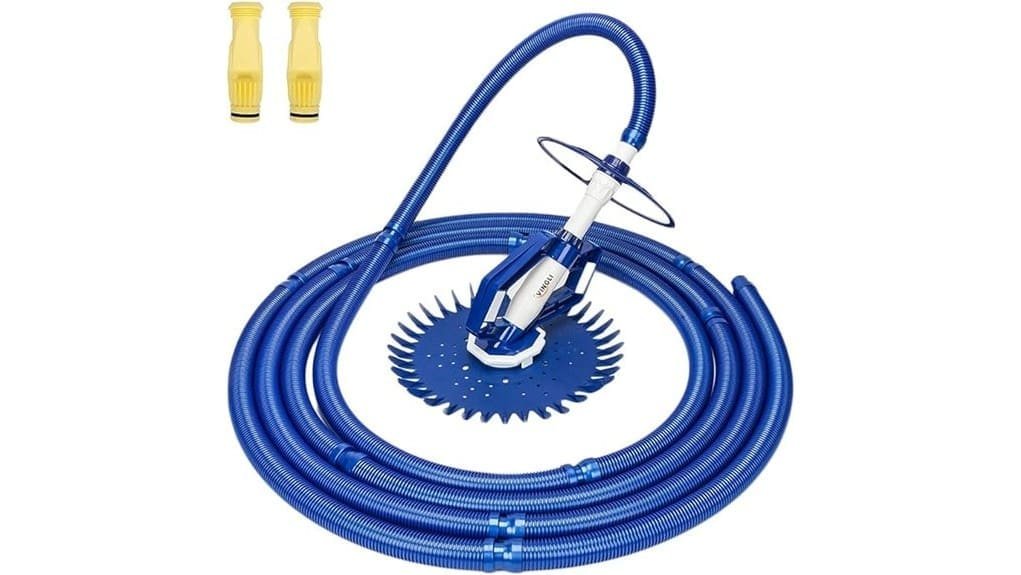
You’re looking at a budget-friendly, suction-powered cleaner that’s best if you’re fighting algae, dust, and fine debris rather than leaves and twigs. It hooks to a ≥3/4 hp pump and uses long scuff-resistant hoses and spare diaphragms—quiet and low-effort compared with robots. Navigation can be quirky around steps and edges, and performance depends on steady pump flow, so weigh its cost and limits against your pool’s debris profile before you explore full details.
Some Key Takeaways
- Excellent suction for algae, dirt, and dust when paired with a ≥3/4 hp pump (6.5 m3/hr flow) and proper filtration.
- Quiet, low-effort suction-powered cleaner ideal for small in-ground and compatible above-ground pools with matching hose layout.
- Struggles with leaves, large twigs, and heavy yard debris—keep a leaf skimmer for larger items.
- Navigation can be inconsistent around steps, tight corners, and waterline edges despite wheel deflectors.
- Includes durable scuff-resistant hoses, two spare diaphragms, and basic fittings, but requires correct pump setup and hose sealing.
Who the VINGLI Automatic Sweeper Is Best For
If you mostly fight algae, dirt, and dust in an in-ground pool and want a low-noise, low-effort cleaner, the VINGLI Automatic Sweeper is a strong fit; it’s best for owners with a 3/4 hp (or greater) pump and a filtration system you can attach the included hoses to. You’ll find it ideal if you’re homeowners with small pools who need efficient suction on floors and walls. Compared to pricier robotic models, it’s budget friendly and suits budget conscious buyers looking for reliable algae and dust removal. Avoid it if leaves dominate your maintenance needs; it’s weak on large debris. It’s especially appealing to homeowners focused on enhancing their outdoor spaces with dependable, targeted cleaning for above-ground pools outdoor living.
What’s in the Box and Key Specs You Should Know
Unpack the VINGLI and you’ll find the essentials for a suction-powered pool cleaner: a blue polypropylene/nylon sweeper body, ten 33-foot scuff-resistant hoses, two yellow replacement diaphragms, and basic fittings to attach to your filter—no power supply included. These box contents are pragmatic: hoses match typical in-ground layouts, diaphragms cover wear, fittings assume you use an existing pump. Key specs matter — requires ≥3/4 hp pump or 6.5 m3/hr flow, 5-pound load capacity, scuff-resistant materials, adjustable controls — so you compare compatibility before buying. Assembly’s user-driven; maintenance tips and warranty provide modest reassurance. Choose the hose length based on your yard’s layout to ensure full pool coverage and efficient cleaning pool vacuum hoses.
Real-World Performance: Suction, Navigation, and What It Misses
Now that you know what’s in the box and the basic specs, let’s look at how the VINGLI actually performs in a working pool. You’ll notice strong pickup on fine dirt and algae but some suction variability depending on pump flow; meet the 3/4 hp requirement for best results. Navigation quirks appear around steps and tight corners despite the wheel deflector—you’ll still guide it occasionally. It handles walls and floor well, though edge performance on the waterline is uneven. Expect missed debris types like leaves and large twigs; it’s optimized for small particles, not heavy yard fallout. For homeowners who value low-maintenance outdoor spaces, consider robotic vacuums as part of your regular pool care routine and automated pool maintenance can reduce manual cleaning time.
Setup, Maintenance, and Troubleshooting Tips
Although assembly’s straightforward, pay attention to hose integrity and pump requirements so you won’t waste time troubleshooting flow issues later. You should confirm your pump meets 3/4 hp or 6.5 m3/hr flow, fit hoses tightly, and practice basic hose care to avoid air leaks. Compare pressure and movement after each adjustment; tweak weights and regulator valve for smoother navigation. If performance drops, run a diaphragm inspection—check mouth edges for cracks or wear and swap the yellow spare. Regularly clear filters and inspect connections. These steps minimize downtime and let you evaluate whether issues are hose-, pump-, or diaphragm-related. For homeowners who enjoy their outdoor spaces, choosing the right pool vacuum head can make maintenance easier and more effective.
Pros, Cons, and Final Buying Recommendation
After following the setup and maintenance steps, you can judge this cleaner by what it does best and where it falls short. Pros: strong suction tackles algae, dirt, and dust efficiently; quiet noise levels let you run it without disturbance; durable hoses and included spare diaphragms lower upkeep. Cons: poor leaf handling and limited load capacity mean you’ll still need a leaf skimmer; no battery life concern since it’s suction-powered, but pump specs must be met. Final recommendation: buy if you want low-noise, low-maintenance floor/wall cleaning and reliable warranty coverage; skip it if leaves are your main problem. It’s a great choice for homeowners who want an effortless pool cleaning solution that complements their outdoor living space.
Some Questions Answered
Does It Work With Above-Ground Pools?
Not ideal — it’s designed for in-ground pools, so you’ll likely face pool compatibility issues with above-ground setups. The suction-powered unit needs a pump flow and stable mounting that above-ground pools often lack. With 33 feet of hose length you could reach many above-ground pools, but performance will be reduced and it won’t handle leaves well. You’ll want a model specifically rated for above-ground pools for reliable results.
Can It Connect to a Variable-Speed Pump?
Yes — you can connect it to a variable-speed pump, but you’ll want to make certain proper variable speed compatibility by keeping flow within its minimum (6.5 m3/hr) or using a higher speed setting. You’ll likely notice lower pump noise at reduced speeds, yet cleaning efficiency may drop. Comparatively, a fixed-speed pump gives steadier suction; a variable-speed lets you balance noise versus performance. Adjust weights and regulator for best results.
Are Replacement Hoses Sold Separately?
Yes — you can buy replacement hoses separately; the package already includes ten, but extra hose adapters are available if you need extensions. You’ll want to check material compatibility (polypropylene, nylon) with your pool and pump fittings to avoid degradation or leaks. Compared to generic hoses, OEM replacements match the sweeper’s scuff-resistant construction and fit, so you’ll get better durability and consistent suction performance than mixing mismatched hose materials.
Is Professional Installation Available?
No — professional installation isn’t typically offered by the seller for this unit; you’ll likely handle user assembly yourself. If you prefer, you can hire professional installation from local pool services or certified installers, which may cost more but gives expert setup and peak performance compared to DIY. That choice reduces risk of leaks, air in hoses, or misadjusted regulator valves, and can be worth it if you value time and guaranteed reliability.
Does the Warranty Cover Accidental Damage?
No, the warranty generally won’t cover accidental damage. You’ll find warranty exclusions for misuse, impacts, and improper installation. If you believe damage qualifies, follow the claim process promptly: contact the seller, provide photos and purchase info, and request evaluation. Compare offered remedies—repair, replacement, or denial—and ask about deductible options if third‑party protection applies. You’ll want documented responses to challenge any unjust exclusions.