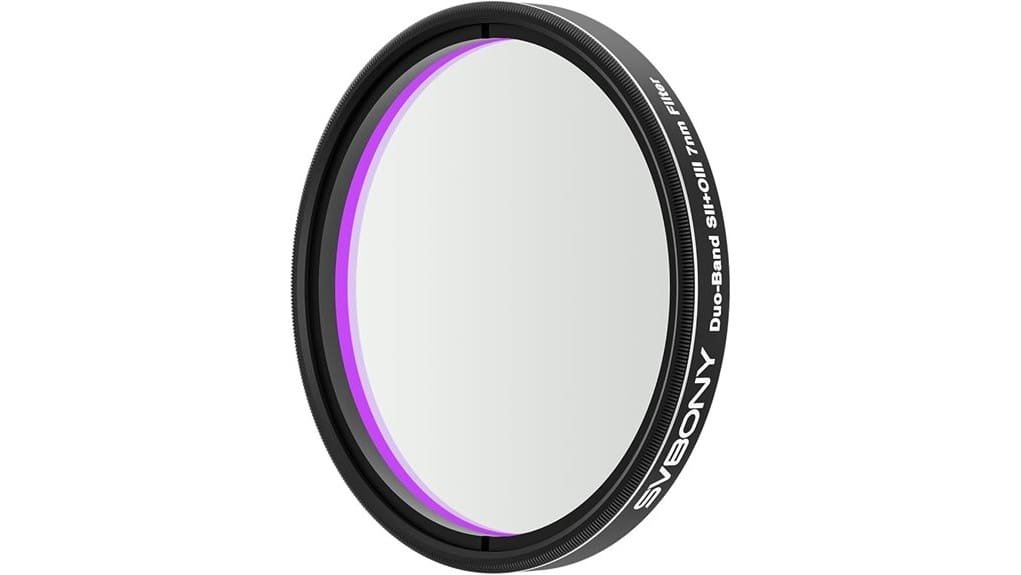
If you’re after affordable narrowband performance, the SVBONY SV220 gives dual 7 nm SII/OIII bands that boost contrast on emission nebulae and cut many light-pollution spectra. It shows high in-band transmission with sharp OD5 blocking and works well on modern sensors when paired with narrowband calibration frames. Use it on faster optics (preferably Although it’s an affordable option, the SVBONY SV220 delivers targeted performance for emission nebula imaging and is worth considering if you need a budget-friendly dual-band filter. You’ll find it effective for improving contrast on SII and OIII targets while keeping cost low. For practical use, integrate the SV220 into your imaging workflows with narrowband calibration frames to maintain color balance and remove sensor artifacts. It suits fast optics (> f/4) and standard 2″ filter holders, though it isn’t water resistant. If you require precise rejection and mechanical robustness, compare it to higher-end narrowband alternatives before buying. For photographers using modern cameras, pairing the filter with Cfexpress memory cards can help manage large raw imaging files during extended capture sessions. Having established the SV220‘s value for budget-minded nebula imaging, let’s examine how its dual 7 nm SII and OIII passbands actually improve contrast and reject light pollution. You’ll see targeted contrast enhancement because the narrow 7 nm bands isolate dominant emission lines, boosting signal from SII and OIII regions while suppressing continuum. That narrowing reduces sky background and broadband lamp spectra, so pollution rejection improves under city and moonlit skies. In practice you’ll capture cleaner line emission with shorter cumulative exposure for similar signal-to-noise. Expect trade-offs on faint continuum detail, but net gain for emission-nebula work. This makes it especially useful for photographers seeking accurate color and detail when paired with monitor calibration workflows. When you test the SV220, its high in-band transmission and sharp OD5 cutoffs produce a clear separation between target emission and background light, so nebular SII and OIII lines pass efficiently while continuum and common light-pollution wavelengths are suppressed. You’ll measure peak transmission above typical narrowband norms, improving SNR on modern sensors, though you must account for sensor response and any QE roll-off. Spectral calibration in your workflow confirms band centers near nominal 7 nm. Long-term performance depends on coating durability; monitor for filter aging that shifts profile. Real-world frames show stronger contrast and manageable background. For landscape photographers using gradient filters, consider how graduated ND filters control sky brightness for balanced exposures in wide-field scenes. Because the SV220 is optimized for faster optical systems, you should plan to use it on telescopes with effective focal ratios faster than f/4 to guarantee bandpass shifts and vignetting that can degrade narrowband performance. You’ll get best results on fast refractors and fast astrographs; slower systems risk central wavelength drift. The 2″ size fits standard 2″ filter slots and 48mm threads, but confirm mechanical clearance in focusers and adapters. Use low-profile telescope adapters to minimize backfocus changes. Check for sensor vignetting with your camera and field stop—full-frame sensors may need additional testing to guarantee even illumination. Consider also carrying a dedicated camera bag insert to protect and organize your filters and adapters in the field. Although the SV220 sits in the mid-range price tier for dual-band narrowband filters, it delivers value through its OD5 blocking, dual 7 nm passbands, and included protective case—you’ll pay for performance rather than premium branding. Your purchasing decision should weigh the pricing strategy against comparable filters; SV220 targets budget-conscious imagers needing reliable narrowband isolation. Package contents are minimal: one 2″ SII/OIII filter and a plastic box. Warranty covers one year; customer support and a 30-day return policy are standard. If you want low-cost, high-contrast nebula imaging, buy it; skip it if you need water resistance or premium optics. Many diving photographers also appreciate using ruggedized accessories to protect gear in wet environments, especially when shooting near or on the water with protective cases. Yes — you can use it visually, but with limits. You’ll notice enhanced contrast on bright emission nebulae and reduced skyglow, especially with eyepiece adaptors fitting 2″ holders. It’s optimized for astrophotography and for systems faster than f/4, so stars may dim and faint structure can be muted visually. Expect color shifts and reduced overall brightness; use it on bright nebulae and in light-polluted skies for best visual observing results. It causes a pronounced color shift: broadband stars and continuum sky are heavily attenuated while SII and OIII emission lines pass, so your RGB balance skews toward green/blue OIII and red SII depending on target. You’ll get strong contrast enhancement for emission nebulae but altered star colors and muted broadband detail. You’ll need either narrowband-only workflows or careful color calibration, synthetic recombination mapping, and selective blending to restore natural color. Yes — you’ll find the SV220 compatible with sensors behind IR-cut filters. Sensor compatibility depends on your camera’s spectral response and the filter’s transmission curves: the SV220 passes narrow SII and OIII bands (7 nm) while blocking others (OD5), so typical IR-cut coatings won’t interfere with intended emissions. Check your camera’s quantum efficiency near 486–672 nm and compare to the SV220 transmission curves to confirm peak signal throughput. Yes — you can stack it with other narrowband or light‑pollution filters, but you’ll need to evaluate stacking considerations and transmission interactions. You’ll preserve SII/OIII benefits if the added filter’s passbands don’t shift or attenuate those lines. Avoid overlapping narrowband peaks or mismatched bandpasses that reduce throughput or cause color bias. Test combinations on target and monitor total transmission loss; adaptor threads and added reflections can also affect results. Use a gentle, staged cleaning: first blow loose dust away with an air duster, then remove remaining particles with a soft microfiber swab lightly moistened with optical-grade cleaner. Don’t rub hard; use slow, single-direction strokes from center outward. For fingerprints, repeat moistened swab passes until clear, then finish with a dry microfiber swab. Avoid canned solvents, abrasive cloths, or soaking the filter; don’t expose the housing to water.Some Key Takeaways
Quick Verdict: Is the SVBONY SV220 Worth Buying for Nebula Astrophotography?
How the Sv220’s Dual 7 Nm SII & OIII Bands Affect Contrast and Light Pollution Rejection
Optical Performance: Transmission, Cut-off (OD5), and Real-World Imaging Results
Use Cases and Compatibility: Telescopes, F-Ratio (>F/4), Filter Slots, and Mechanical Fit
Price, Warranty, Package Contents, and Who Should (or Shouldn’t) Buy It
Some Questions Answered
Can the SV220 Be Used Visually on an Eyepiece for Nebula Observing?
How Does the Filter Affect Color Balance in Broadband Astrophotography Frames?
Is the SV220 Compatible With Camera Sensors That Have Ir-Cut Filters?
Can the Filter Be Stacked With Other Narrowband or Light-Pollution Filters?
What Cleaning Methods Safely Remove Dust or Fingerprints From the Filter?

Grill Caddy for Outdoor Grill Review
Whether you’re chasing breezy backyard cooks or campsite convenience, discover how this weather-ready grill caddy keeps everything within reach and what to watch for next.