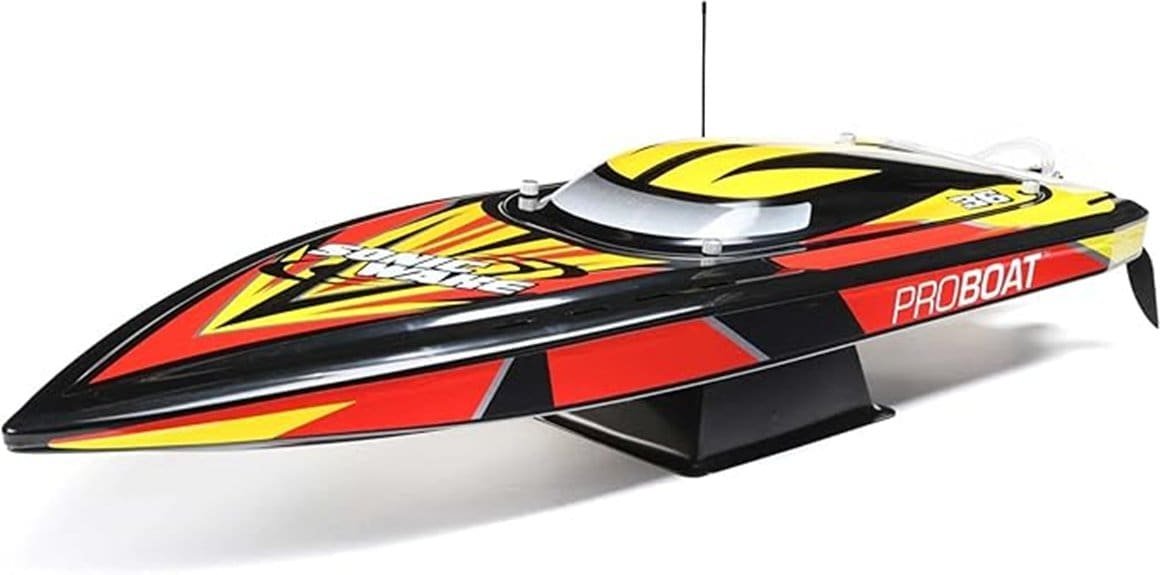
You’ll get a race-ready 36″ Deep‑V that’s tough, fast, and forgiving—ideal if you want high performance without building from scratch. It comes RTR with a Spektrum FIRMA 1900KV motor, 120A marine ESC, SR315 receiver and SLT3 radio; you just add LiPo packs and a charger. Handling is predictable, self‑righting works, and the water‑cooled motor fights fade. It’s not a toy—plan on tuning and battery care to access full potential if you keep exploring.
Some Key Takeaways
- Powerful Spektrum FIRMA 1900KV motor and 120A marine ESC deliver race-ready acceleration and sustained top-end performance.
- Deep-V hull with self-righting design offers predictable handling, tight turns, and forgiving performance in chop.
- Robust construction: sealed battery compartment, reinforced mounts, waterproof seals, stainless prop shaft, and precision propeller.
- Requires separate high-discharge 3S–4S LiPo batteries and charger; tuning and battery safety are essential.
- Best for racers and serious hobbyists seeking near-pro performance; not for casual plug-and-play buyers.
Pro Boat Sonicwake V2 36 At a Glance : Verdict and Who It’s For
Although it’s built for racers, the Pro Boat Sonicwake V2 36” is just as well suited to hobbyists who want a durable, high-performance RTR boat you can take right to the water. You’ll get a rugged Deep-V hull and self-righting design that forgivingly handles flips and chop, so you can push speed without constant worry. It’s beginner friendly enough for newcomers who value reliability, yet tuned for experienced pilots seeking crisp throttle response. For family fun weekends and competitive outings alike, this model balances durability, performance, and ease of use—an authoritative pick if you want versatility in one package. It also pairs well with long days at the shore when you want to keep your gear secure with a quality surfboard leash.
What’s Inside the Box and Key Specs (Motor, ESC, Radio, Hull)
Inside the box you get a race-ready package: the 36″ Sonicwake V2 hull plus a Spektrum FIRMA 1900KV 4-pole water-cooled brushless motor, Spektrum 120A marine ESC, Spektrum SR315 dual‑protocol receiver, and an SLT3 2‑channel 2.4GHz DSMR transmitter—everything meant to deliver high-speed, reliable performance out of the crate (batteries and charger not included). You’ll find a deep-V hull with reinforced servo mounts and a sealed battery compartment sized for common metal packs. Waterproof seals protect electronics and the motor cooling. The stainless prop shaft and precision propeller are fitted for efficient thrust. Assembly is minimal; components feel robust and serviceable. For those who take their gear to the shore, consider protecting your camera and other devices with waterproof cases designed for beach and outdoor use.
On-Water Performance: Speed, Handling, Self-Righting, and Durability
With the hardware already described, what matters most is how the Sonicwake V2 actually runs on water. You’ll find sprinting speed impressive for a 36″ Deep-V; acceleration is punchy and top-end feels race-ready. Handling is predictable—tight turns, solid tracking, and confidence when trimming through chop. Self-righting works reliably after flips, getting you back racing fast. Wave interaction is managed by the hull profile, shedding slaps and minimizing porpoising. Durability holds up to hard use; plastics and hardware resist impacts. Thermal management from the water-cooled motor keeps power consistent under prolonged runs, reducing throttle fade. For transporting and protecting your board, choosing the right surfboard bag is essential, especially one offering padded protection and durable materials like those recommended for surfboard bags.
Setup, Battery Choices, and Common Tuning Tips for Racing
When you’re prepping the Sonicwake V2 for racing, prioritize a battery and setup that match its high-power brushless system to get consistent acceleration, cooling, and handling. Choose high-discharge LiPo packs (3S–4S depending on track) for reliable voltage under load; Battery selection should balance capacity and weight to preserve trim. Check Motor gearing to avoid overheating or wasted top-end—steeper gearing for sprints, milder for tight courses. Fine-tune ESC settings for punch, timing, and thermal protection; enable braking sparingly. Test Prop choices (diameter, pitch, cupping) on calm water, logging temps and RPMs, then iterate for peak speed and control. For beach and outdoor use, consider speakers and accessories designed for waterproof performance to enhance post-race enjoyment.
Pros, Cons, and Should You Buy the Sonicwake V2 36?
Although it’s packed with high-end components and race-ready features, the Sonicwake V2 36” makes a clear tradeoff between outright performance and practical ownership. You get robust build quality, a powerful FIRMA motor, 120A marine ESC, and self-righting Deep-V stability—excellent for fast, confident runs. Downsides: batteries and charger aren’t included, and its speed demands strict battery safety and a disciplined maintenance schedule to avoid failures. Buy it if you want near-pro performance in an RTR package and you’re prepared to invest in proper batteries, chargers, and upkeep. Skip it if you want a totally plug-and-play toy. Check out our selection of action camera gear to capture your beach runs and shore-side footage.
Some Questions Answered
Is Replacement Hardware Available From Pro Boat or Third Parties?
Yes — you can get replacement parts from Pro Boat and from third party suppliers. You’ll find factory components (hulls, motors, electronics) via Pro Boat support or authorized dealers, and aftermarket options (prop shafts, hardware, upgraded motors, housings) through hobby shops and online marketplaces. You should confirm compatibility with your PRB08032V2T1, check part numbers, and consider warranty/quality differences before buying third party alternatives.
Can I Use This Boat in Saltwater Without Extra Corrosion Protection?
No, you shouldn’t use it in saltwater without extra corrosion protection. Saltwater maintenance is critical: rinse thoroughly with fresh water after every run, dry, and flush the cooling system. Replace exposed hardware with anodizing options or stainless steel, coat electronics and metal parts with corrosion inhibitor, and use sacrificial anodes if practical. You’ll extend lifespan and reliability by proactively protecting the motor, ESC, props, and fittings.
Are There Recommended Propeller Sizes Beyond the Stock One?
Yes — you can fit aftermarket props to tweak performance. You’ll generally stick close to the stock diameter but try different pitch options (higher pitch for top speed, lower for acceleration/handling). Choose marine-grade materials and match shaft size and spline count. Test increments of 0.5–1.0″ pitch and monitor motor/ESC temps and current draw. If you see excess heat or draw, step back to a lower pitch to protect components.
What Warranty Process and Coverage Details Are Provided by Customer Service?
You contact customer service to start a warranty claim; they’ll evaluate and authorize repairs or replacement under the manufacturer warranty. Expect a warranty turnaround window based on parts and shipping; they’ll tell you estimated timelines. Coverage excludes damage from misuse, water intrusion beyond normal operation, or unauthorized modifications — those are claim exclusions. Keep proof of purchase and photos ready; you’ll get instructions and tracking updates once the claim’s approved.
Is There an Optional GPS or Telemetry Upgrade Compatible With the SR315 Receiver?
Yes — you can add external telemetry and a third party GPS to the SR315, but you’ll need compatible hardware and wiring. The SR315 supports telemetry via Spektrum protocols; add a Spektrum telemetry module or a compatible third-party telemetry unit that outputs sensor data. For GPS, use a DSMR-compatible GPS/telemetry module or an external GPS that feeds into your telemetry module. You’ll configure sensors in your transmitter and verify wiring before use.