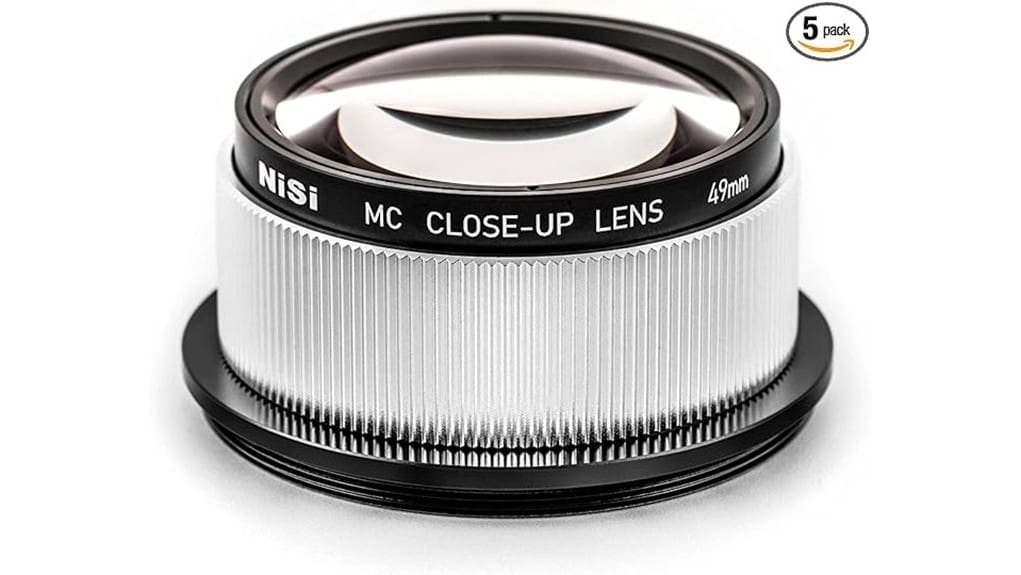
You’ll get true 1:1 close‑up capability on long lenses at a low price, with strong central resolution, high microcontrast, and neutral apochromatic color. It threads to 49 mm and ships with 62→49 and 67→49 adapters, weighs about 200 g, and lacks weather sealing, stabilization, and AF. Edges soften and working distance is tight, so handheld macro needs care or stacking. Keep going and you’ll find detailed performance, compatibility, and value notes.
Some Key Takeaways
- Compact 49 mm +9 diopter kit provides true 1:1 magnification on long lenses, ideal for portable macro work.
- Apochromatic glass and nano coatings deliver strong central resolution, neutral colors, and minimal lateral fringing.
- Edge sharpness and chromatic control fall off toward the periphery, so careful composition or stacking is recommended.
- Includes 62→49 mm and 67→49 mm adapters, two caps, case, and 12-month warranty; weighs ~200 g.
- Best for users valuing affordability and portability over AF, weather sealing, and perfect edge-to-edge optics.
Verdict Up Front: Is the NiSi 49mm NC Close‑Up Lens Kit Worth Buying?
While the NiSi 49mm NC Close‑Up Lens Kit won’t replace a dedicated macro lens, it’s a compact, affordable way to get true 1:1 magnification on long glass and close-focus capability on standard lenses. You’ll find it compelling if you prioritize portability and a low price comparison against buying a second macro lens. Evaluate build durability: the optical glass and nano coating feel solid for travel use, though it lacks weather sealing and stabilization. You’ll accept trade-offs in optical perfection for weight, cost, and convenience. Buy it when budget and flexibility outweigh absolute image-edge and autofocusing needs. It’s particularly useful for photographers who already use teleconverters to extend reach and want greater versatility without adding bulky gear.
How the NiSi 49mm NC Optics Perform: Resolution, Color, and Fringing
Although it’s a small add-on, the NiSi 49mm NC delivers notable resolution and color fidelity for a close-up diopter, so you can expect usable 1:1 detail on long lenses without extreme chromatic artifacts. You’ll notice strong central resolution; microcontrast remains high and fine texture resolves well at close focus. Color reproduction stays neutral thanks to apochromatic elements and NiSi’s nano coatings, preserving hue shifts. Lateral fringing is minimized, with only minor purple/green at extreme edges. Edge sharpness falls off toward the frame periphery but stays acceptable for hand-held macro work and careful composition. These characteristics make it a practical option for photographers looking to improve close-focus capability with polarizing filters and other outdoor accessories.
Real‑World Shooting: Working Distance, Magnification, and Sample Use Cases
Having established the NiSi 49mm NC’s resolution and color behavior, let’s examine how its working distance and magnification affect real shooting scenarios. You’ll find useful close-focus from roughly 2–14 cm, yielding about 1:1 on full-frame (higher effective magnification on APS‑C/4/3). That proximity produces pronounced light falloff at wide apertures; stop down or use even illumination to retain edge detail. Handheld shooting is feasible with telephoto reach but demands steady technique or higher shutter speeds because depth of field is razor-thin. For subjects like flowers, product details, and insects you can shoot single-frame macro or employ focus stacking for extended depth. For further gear options and compatibility, consider Master Macro’s guide to choosing the right extension tubes extension tubes when planning setups.
Compatibility and Mounting: Which Lenses, Bodies, and Adapters Work Best?
Because the NiSi 49mm NC threads onto any 49 mm filter mount (and includes 62→49 mm and 67→49 mm step‑down adapters), you can use it on a wide range of telephoto and standard lenses to get true close‑up performance without a dedicated macro lens. You should prioritize lenses with longer focal lengths (70–300 mm) for working distance and easier framing; it also mounts on Canon, Nikon, Sony, and Micro Four Thirds bodies with predictable crop‑factor magnification. Check lens compatibility for protruding front elements or filter collars. Adapter options are limited to included step‑downs; using additional step‑up rings may introduce vignetting or instability. For photographers concerned about workflow and storage, consider choosing a compatible SD card with sufficient speed and capacity to handle high-resolution photos and burst shooting, such as a high-speed SD card.
Value, Kit Contents, and Warranty: Who Should Buy This Close‑Up Lens?
Weighing in at about 200 g with a compact kit (49 mm +9 diopter close‑up lens, 62→49 mm and 67→49 mm step‑down adapters, two caps, and a protective case), the NiSi 49mm NC offers a high‑value, portable macro solution for photographers who want true 1:1 close‑up capability without buying a dedicated macro lens. You get apochromatic optics, nano coatings, and adapters that broaden compatibility with minimal bulk. In price comparisons it undercuts many short‑tele macro primes; user testimonials praise resolution and color but note working‑distance limits. Buy this if you need affordable, travelable macro performance and accept manual focus and a 12‑month warranty. The site also sells related products for keeping optics clean and protected, including microfiber cloths and lens cleaning solutions for lens cleaning.
Some Questions Answered
Does the Lens Affect Autofocus Performance on Modern Cameras?
Yes — you’ll see reduced autofocus speed and reliability when using this close-up lens. Adding diopters increases optical complexity, so autofocus hunting becomes more frequent and slower, especially near close working distances. You’ll often need focus calibration or switch to manual focus for critical shots. On modern contrast-detect or hybrid systems performance varies; phase-detect AF may still struggle, so plan to confirm focus and fine-tune settings.
Can I Stack This Close‑Up Lens With Other Filters?
Yes — you can stack this close‑up lens with other filters, but you’ll introduce potential optical degradation. When you add additional glass elements (UV, polarizer, ND), contrast and sharpness can drop and flare or ghosting may increase, especially with strong light sources. Keep stacks minimal, use high‑quality multi‑coated filters, and test for vignetting on wide-angle lenses. For critical work, prefer single high‑quality elements to avoid cumulative optical degradation.
Is the Kit Weather‑Sealed for Outdoor Use?
No — it isn’t fully weather‑sealed, so you shouldn’t assume environmental protection. You’ll get NiSi’s nano coating that offers water and grease repellence and easier cleaning, which improves weather resistance for light moisture and splashes, but the mechanical assembly and adapters lack full sealing. If you’ll shoot in rain, heavy humidity, or dusty conditions, plan sealing precautions (rain cover, silica packs) and accept sealing concerns as a limitation.
Will It Work With Non‑Nisi Step‑Up/Step‑Down Rings?
Yes — you can use non‑NiSi step‑up/step‑down rings, provided the threads match (49 mm to your lens). That adapter compatibility is mechanical only; it won’t alter the close‑up lens’s optical performance if rings are rigid and centered. Use high‑quality, snug metal adapters to avoid tilt or vignetting. Avoid cheap, loose plastic rings that can introduce decentering, light leaks, or reduced sharpness across the frame.
Can I Use It With Teleconverters or Extension Tubes?
Yes — you can use it with teleconverters or extension tubes, but expect trade-offs. Teleconverter compatibility depends on flange clearance and optical path; adding a teleconverter may reduce effective diopters and introduce aberrations. Extension tubes increase magnification but shorten working distance; avoid excessive tube stacking to prevent light loss and vignetting. Evaluate on your lens: test for focus ability, AF performance, and image quality degradation before committing to critical shoots.