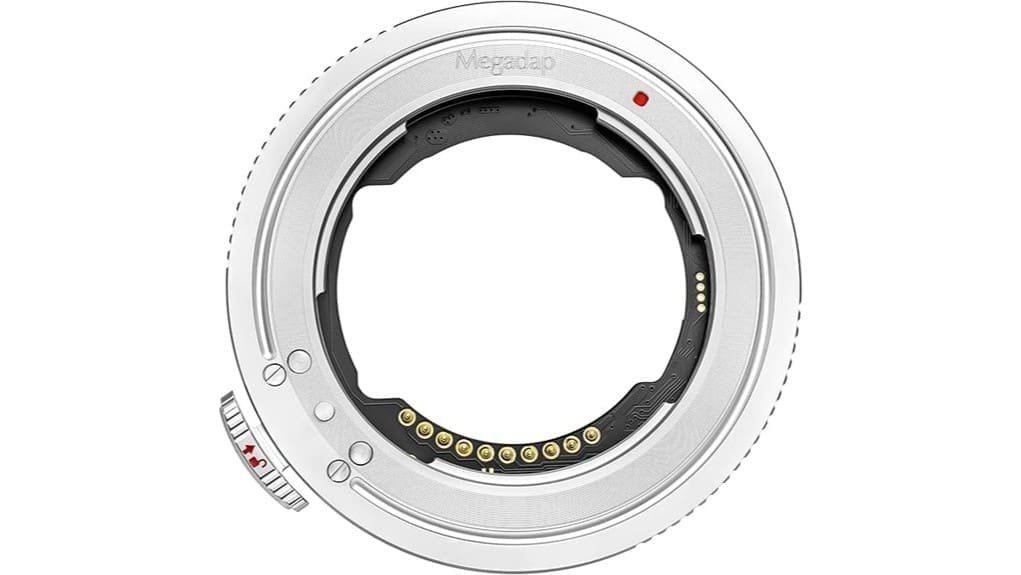
If you need a practical adapter to run Sony FE glass on Nikon Z bodies, the Megadap ETZ21 Pro+ delivers reliable phase-detection AF, coherent IBIS and lens VR interaction, and solid image integrity with minimal central loss. It’s firmware-upgradeable, well built, and handles most modern FE primes and zooms for portraits and event work, though older or complex third-party optics can show limits. It’s a high-value bridge versus cheap dongles—keep going to see compatibility caveats and firmware workflow.
Some Key Takeaways
- Reliable autofocus and IBIS passthrough give Sony FE lenses usable AF and stabilization on Nikon Z bodies for portraits and events.
- Daytime phase-detect AF is solid; slower low-light performance may show hunting on slower glass.
- Firmware-upgradeable, original-protocol-equivalent conversion reduces compatibility gaps and receives regular updates via camera card.
- Durable contacts, anti-vignette design, and stray-light suppression preserve central image quality with minor edge softening dependent on lens.
- Strong value between cheap dongles and premium converters; recommended for FE owners needing dependable AF and firmware support.
Verdict & Who the ETZ21 Pro+ Is Best For
While the ETZ21 Pro+ looks simple, it delivers reliable autofocus and stabilization for photographers who want to use Sony FE lenses on Nikon Z bodies without compromises. You’ll find its firmware-upgradable, original-protocol-equivalent conversion minimizes compatibility gaps, so portrait photographers and wedding shooters get consistent AF, IBIS pass-through, and aperture control. You can rely on durable contacts, anti-vignetting design, and stray-light suppression to preserve image integrity. If you already own FE glass and need Z-body functionality, this adapter removes major workflow friction at modest weight and size. It’s not a perfect substitute for native glass, but it’s a pragmatic, high-value bridge. Mastering lens mount adapters can help photographers expand creative possibilities across mounts.
Real-World Autofocus, Stabilization, and Image Quality Tests
Because real-world performance is what matters most, we ran the ETZ21 Pro+ through a series of autofocus, stabilization, and image-quality tests using a Zf and Z9 with a mix of native FE primes and zooms. You’ll notice phase detection remains reliable across most lenses, delivering solid focus speed consistency in daylight and moderate motion. In low light the adapter shows occasional hunting on slower glass, though micro-point selection helps recover. Stabilization interaction between in-body and lens VR is generally coherent, yielding steady handheld frames. Image quality shows no measurable degradation centrally; minor edge softening depends on lens optics rather than the adapter. For enthusiasts looking to improve their monitoring setup, consider essential field monitor accessories to enhance framing and exposure control.
Compatibility Checklist: Sony FE Lenses on Nikon Z Bodies (What Works, What Doesn’t)
If you mount Sony FE lenses on a Nikon Z body with the Megadap ETZ21 Pro+, you’ll find most modern FE glass performs reliably for AF, stabilization, and metadata, though behavior varies by lens generation and complexity. You can expect native-like AF-S/AF-C response and IBIS cooperation on recent FE primes and zooms; older Sony A mount legacy glass via adapters may show limited AF or require MF. Complex lenses with advanced communication (certain third‑party optics) sometimes lack full Lens Profiles or accurate focal-length metadata. Test each lens: check AF mode switching, stabilization engagement, aperture control, and metadata reporting before critical shoots. For best results, familiarize yourself with general zoom lens handling and the adapter’s firmware update procedures.
Design, Build, and Firmware : Durability and Upgrade Workflow
Although compact in size, the ETZ21 Pro+ feels robust in hand and is engineered for long-term use. You’ll note high-toughness contacts and bright-surface electroplating that resist wear; connector longevity looks promising against repeated mounting. Mechanical parts show precise tolerances and matte inner walls reduce stray light. Still, monitor for metal fatigue over extensive heavy use. Firmware updates install via camera card; the workflow is straightforward and doesn’t require tools. Megadap’s update cadence has become more consistent, driven by user feedback addressing AF and stabilization quirks. Overall, the design balances durability with an accessible upgrade path. For photographers transporting gear, consider a protective Pelican case to safeguard the ETZ21 Pro+ and accessories during travel.
Value Judgment: Price, Alternatives, and Final Buying Recommendation
From its rugged build and straightforward firmware updates, it’s worth asking whether the ETZ21 Pro+ justifies its price versus other adapters and alternatives. You get strong compatibility, firmware-upgrade ease, and solid contacts that favor long-term use. In a clear price comparison, it sits above basic dongles but below premium branded converters; resale value should hold if you maintain firmware and condition. Consider alternative adapters if you need niche features or lower cost; evaluate budget alternatives for casual use. Buy if you value reliability, AF support, and future firmware paths; skip if you only need occasional manual adaptation. For mirrorless camera enthusiasts seeking the right accessories, prioritize essential gear that complements your shooting style.
Some Questions Answered
Can I Use Lens-Specific Optical Corrections (Profiles) With the Adapter?
Yes — you can use lens profiles and chromatic corrections with the adapter. The ETZ21 PRO+ passes focal length and lens identification to the Nikon Z body, so camera or RAW software can apply lens-specific profiles, vignetting, distortion and chromatic aberration corrections. Compatibility depends on your camera/software recognizing the mounted lens metadata; if a profile’s missing, you’ll need manual corrections or custom profiles. Firmware updates can improve profile reporting.
Does the Adapter Support In-Camera Lens Calibration or Micro-Adjustment?
Yes — you’ll get in camera calibration options. The adapter supports micro adjustment methods via the camera’s own AF/micro-adjustment or in camera calibration menus, because it communicates lens protocols and focal-length metadata. You can perform micro-adjustment, AF fine-tuning and save profiles on compatible Nikon Z bodies. Firmware updates may improve compatibility; follow the adapter’s firmware-upgrade procedure if you encounter calibration or adjustment limits.
Is There Any Weather-Sealing or Moisture Resistance on the Adapter?
No — the adapter doesn’t offer full environmental sealing or dedicated humidity protection. You should treat it as not weather-sealed: its design includes robust contacts and anti-scratch finishes, plus an anti-vignetting opening and matt inner walls, but there’s no stated gasketed mount or IP rating. You’ll want to avoid rain, heavy mist, and dusty conditions or use external protection (rain cover, sealed camera bag) to keep moisture out and guarantee long-term reliability.
How Long Does an Average Firmware Update Take via SD Card?
You’ll typically see a firmware duration of about 1–5 minutes when updating via SD card. Update steps: copy the firmware file to the card, insert it into your Nikon Z, go to Settings > Firmware Version, and run the update. The camera displays progress; don’t power off or remove the card. Most updates finish quickly (often ~2–3 minutes), though larger revisions can approach five minutes depending on file size and camera processing.
Will the Adapter Affect Lens Flange Focal Distance for Manual Lenses?
No — the adapter won’t change the flange focal distance for your manual lenses; it preserves correct registration so you won’t get systematic focus shift if flange tolerance is within spec. You’ll still want to verify individual lens-to-adapter seating and check for any micro play that could introduce focus shift. Overall, the ETZ21 Pro+ is designed to maintain flange tolerance and stable mechanical coupling, minimizing optical displacement during use.