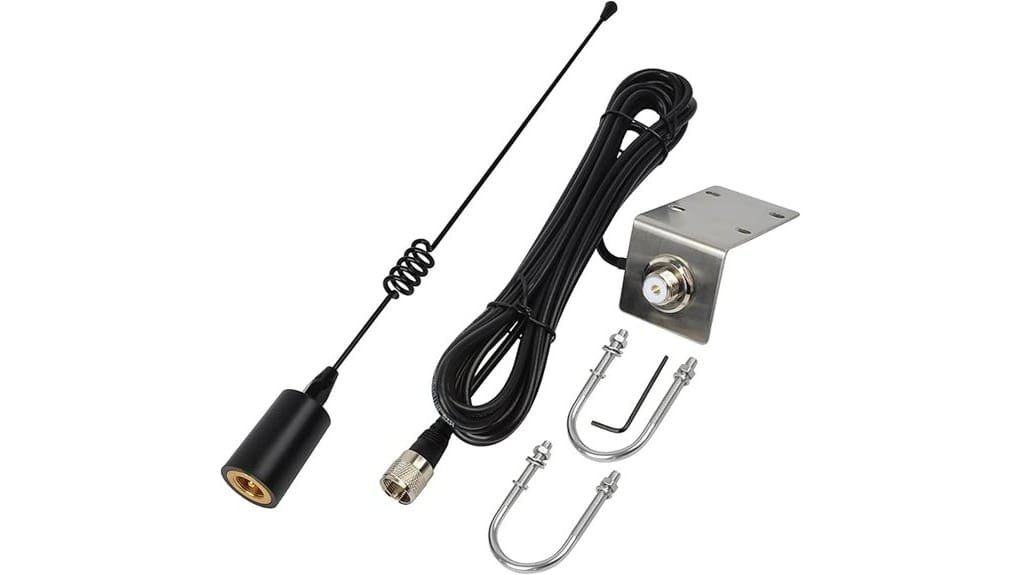
You’ll get a compact, low-profile VHF whip tuned for 156–163 MHz that’s aimed at recreational boaters and coastal anglers. It delivers about 2.5 dBi gain for broad, line-of-sight coverage, handles 50 W, and terminates with 5 m of RG‑58 and a PL259 for simple 50‑ohm hookups. Mounting uses a stainless L‑bracket and U‑bolts; seal and ground carefully. It’s rugged for salt spray but not for long-range or heavy commercial use—more details follow.
Some Key Takeaways
- Low-profile 156–163 MHz whip offers modest 2.5 dBi gain for broad, inshore VHF coverage.
- 50-ohm RG-58 coax with PL259 and 50 W rating suits handhelds and mobile VHF use.
- Included stainless-steel L-bracket and U-bolts simplify plate or pole mounting.
- Rugged radome and stainless hardware resist salt spray and UV for marine durability.
- Best for routine coastal/line-of-sight use; not for extended-range or high-power commercial installs.
What the HYS Marine VHF Antenna Is and Who It’s For
The HYS Marine VHF Antenna is a low-profile, 156–163 MHz whip designed to boost VHF transmit and receive performance on boats and yachts. You’ll recognize it as a single black unit with 5 m RG-58 coax and PL259 connector, 50-ohm impedance and 50 W handling. You’ll mount it on the included stainless-steel L-bracket, plate or pole (mast not included). It’s aimed at recreational boaters and coastal fishermen who need reliable marine VHF comms in a compact package. You’ll appreciate rugged construction for salt exposure and compatibility with Standard Horizon, Icom, Cobra and Uniden radios. It also pairs well with beach lock box setups to help boaters keep valuables safe while ashore.
Real-World Performance: Range, Gain (2.5 dBi) and Power Handling
When you pair the HYS Marine VHF antenna’s 2.5 dBi gain and 50 W power rating with its 5 m RG‑58 lead, expect modest but reliable real‑world performance suitable for typical coastal and inshore operations. You’ll see dependable voice range for routine VHF channels; line‑of‑sight limits still govern reach, so anticipate similar coverage to other low‑profile whips. The moderate gain produces broad beamwidth characteristics that favor horizontal coverage over long narrow lobes. With 50 ohm impedance and simple coax run, impedance matching is straightforward, reducing loss and VSWR risk. Power handling covers handheld/mobile use but not high‑power commercial transmitters. Capture Beach Adventures offers related waterproof camera gear and beach-ready accessories for outdoor enthusiasts, including products designed for coastal photography and marine use with waterproof camera protection.
Installation and Mounting: L-Bracket, U-Bolts, and RG-58 Cable Tips
If you’re mounting the HYS Marine VHF antenna on a boat, use the stainless-steel L‑bracket and supplied U‑bolts to secure a solid, corrosion‑resistant base and run the 5 m RG‑58 coax neatly to your radio. Position the bracket for clear line-of-sight and sufficient clearance from rigging. Tighten U‑bolts evenly; use lock washers and marine-grade sealant on fastener holes. Route the RG‑58 to avoid chafe, support it with clips, and maintain minimum bend radius. Apply proper grounding techniques at the mount and radio end. Inspect PL259 termination regularly for corrosion and follow connector maintenance to guarantee reliable contacts. For beach and surf setups, consider using tripods and mounts designed for sandy, corrosive environments to improve stability and longevity, such as beach tripods that resist salt and sand intrusion.
Durability, Marine Suitability, and Compatibility With VHF Radios
Because it’s built for marine environments, you’ll get a resilient black whip and stainless-steel L‑bracket that resist corrosion and handle exposure to salt spray, sun, and vibration without compromising RF performance. You can expect solid uv resistance from the molded radome and durable plating on mounting hardware, limiting saltwater corrosion over seasons. The 50‑ohm impedance, 2.5 dBi gain, and RG‑58 with PL259 maintain matching and low loss for Standard Horizon, Icom, Cobra, and Uniden radios out of the box. Install securely, torque connectors properly, and inspect seals periodically to preserve performance and longevity. For beach days and boating trips, consider pairing the antenna with floating waterproof cases to protect radios and accessories from water and sand.
Final Verdict: When to Buy This Antenna and When to Choose an Alternative
Although it’s compact and purpose-built for marine VHF use, you should buy the HYS Marine VHF Antenna when you need a low‑profile, corrosion‑resistant whip that matches Standard Horizon, Icom, Cobra, and Uniden radios and delivers modest 2.5 dBi gain with up to 50 W handling over its included 16.4 ft RG‑58 cable. Buy it if you want straightforward VHF performance, easy mounting with stainless hardware, and a value-focused install without adding a mast. Choose budget alternatives if price trumps range or build, and consider long term upgrades (higher gain, stainless mast systems) if you need extended range or heavy-duty durability. Many beach and open‑water swimmers and paddlers use visibility aids like swim buoys to stay safe and seen when sharing waterways.
Some Questions Answered
Does the Antenna Require Grounding or a Ground Plane?
No, the antenna doesn’t strictly require a separate ground plane, but you’ll want a good RF ground or bonding to the vessel for best performance. During installation, check antenna tuning with an SWR meter and adjust mounting height/position to minimize SWR. Installation tips: bond to the boat’s grounding system, use quality coax and proper connectors, keep cable runs short, and seal connections to prevent corrosion for reliable marine service.
Is the PL259 Connector Waterproofed for Marine Use?
No — the PL259 connector isn’t waterproofed out of the box. You’ll want to add waterproof sealing and corrosion protection before marine use. Fit a heat-shrink boot with adhesive, apply marine-grade dielectric grease, and wrap the connection with self-fusing silicone tape or a specialized coax seal to prevent connector corrosion. Inspect periodically and replace seals after heavy exposure to salt spray to maintain reliable RF performance and prevent moisture intrusion.
Can the Coax Length Be Shortened Without Performance Loss?
Yes — you can shorten the coax, but you’ll need proper coax trimming and re-terminate the PL259 to maintain impedance matching. Cut and re-strip the RG-58 cleanly, solder or crimp the center and braid correctly, and keep the new length tidy to avoid excess loss. Avoid abrupt bends and keep total cable loss within budget; if unsure, measure VSWR after trimming to confirm no degradation.
Are Spare Mounting Screws or U-Bolts Available Separately?
Yes — you can get spare fasteners separately; seller policies note replacement mounting options. If you need extra screws or U-bolts, contact the seller or check the manufacturer (QUANZHOU TRUEST) for spare parts lines. You’ll want stainless steel hardware rated for marine use to avoid corrosion. Ask for thread size and hole spacing so replacements match the L-bracket, or source equivalent marine-grade U-bolts and mounting options locally.
Does the Antenna Come With a User Manual or Wiring Diagram?
Yes — the antenna includes basic installation instructions and a wiring diagram in the package. You’ll get guidance for mounting, coax routing, PL259 connection and grounding, plus notes on impedance and power limits. It also references warranty details and how to contact the seller for claims or missing paperwork. If you need a detailed schematic or certified installation sheet, contact the seller or manufacturer for supplemental documentation.