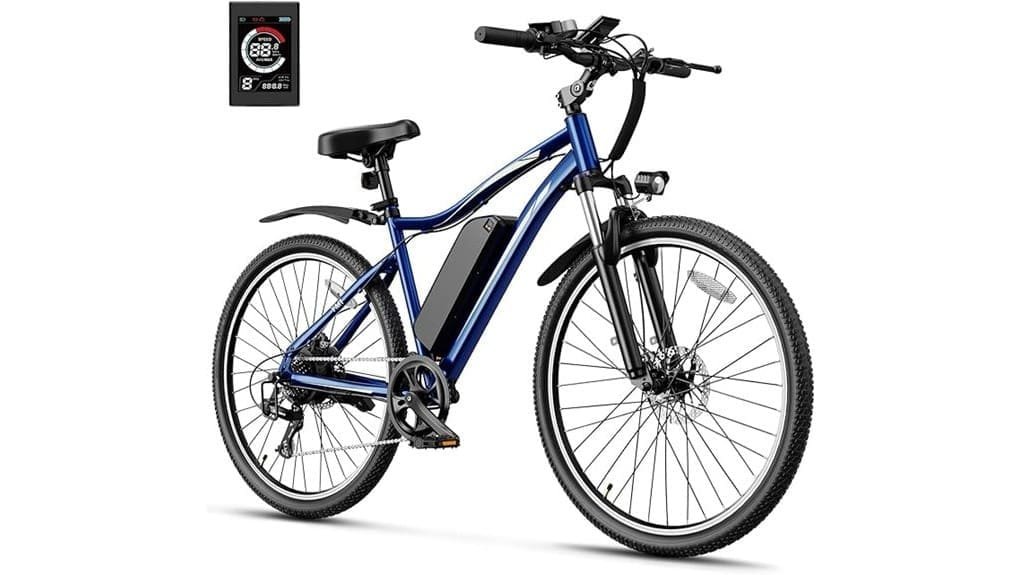
You’ll find the Heybike YM1 is a rugged, cargo-focused 1200W-class e-bike that trades lightweight agility for durable steel construction, reinforced joints, and rack-ready geometry. Its punchy mid-drive-style torque and throttle bursts handle urban starts and loaded hauls, though top speed and range fall short of high-performance models on steep climbs. Ride comfort favors stability over finesse, and the removable 48V battery gives predictable daily range. Keep going to see detailed specs and real-world performance comparisons.
Some Key Takeaways
- The YM1’s sturdy high-carbon steel triangle and reinforced welds prioritize durability and cargo stability over lightweight performance.
- Though claimed at 1200W, practical continuous power feels closer to a 750W-class burst motor for strong starts and moderate climbs.
- Real-world top speed reaches ~22 MPH on flats with light load; heavy riders or hills reduce it to 16–18 MPH.
- The removable 48V 10Ah (480Wh) battery yields about 31–50 miles depending on assist, terrain, and rider weight.
- Comfort favors utility: firm seat, beefy front suspension, and stable handling suited for commuting and cargo, not aggressive sport riding.
What the Heybike YM1 Actually Is : Specs and Design Highlights
While the Heybike YM1 looks like a commuter-friendly e-bike, it pairs a rugged high-carbon steel triangular frame and 27.5″ puncture-resistant tires with a 750W peak brushless motor and a removable 48V 10Ah (480 Wh) battery, delivering a manufacturer-claimed 31–50 miles per charge and up to 22 MPH top speed. You’ll find frame aesthetics favor function: clean welds, reinforced junctions, and a compact battery profile. Compared to lighter alloy models, the YM1 prioritizes durability and load tolerance, improving cargo compatibility with integrated mounting points and a stable geometry suited for racks and panniers without sacrificing basic maneuverability. This makes it a solid choice for riders who want to gear up for outdoor rides and carry extra cargo.
Real-World Riding: Speed, Range, and Motor Performance
The YM1’s beefy frame and 750W peak motor set expectations for practical on-road performance, so let’s measure how that hardware actually behaves under load. You’ll see a marketed top speed vs. real world delta: 22 MPH reachable on flat roads with minimal wind, but loaded climbs or heavier riders often reduce that to 16–18 MPH. Acceleration and torque feel immediate in throttle modes; hill starts and overtakes are solid thanks to the 750W peak burst and 7-speed gearing. Range aligns with 31–50 miles depending on assist level and load. Charging is 5–6 hours; fast-charge trims downtime. Many riders upgrade to higher-capacity batteries for longer trips and improved range performance.
Comfort, Handling, and Build Quality on Different Terrain
Because the YM1 pairs a high-carbon steel triangular frame with a beefy front suspension and 27.5″ puncture-resistant tires, you’ll feel a solid, confidence-inspiring ride on urban streets and compact gravel, though it trades some suppleness for durability compared with lighter alloy frames. You get controlled handling: the suspension soaks medium impacts while the tires roll predictably; cornering feels planted but not nimble. Seat cushioning is firm—supportive for commutes yet offering limited long-ride compliance. Terrain feedback is muted through the bars and saddle, aiding stability but reducing fine-road feel. Build quality is robust; hardware and welds are utilitarian and reliable. The ride pairs well with an ebike-oriented suspension seatpost for added comfort on rough routes and extended outings, especially when choosing models designed for outdoor riding.
Battery, Charging, and Practical Range Expectations
If you rely on the removable 48V 10Ah (480 Wh) battery, expect real-world ranges between roughly 31 and 50 miles depending on assist level, rider weight, terrain, and throttle use. You’ll charge in about 5–6 hours with the stock charger; fast-charging trims time but may affect Battery longevity if used constantly. For consistent performance, adopt a Charge strategy: top off after moderate rides, avoid full depletion, and store at ~50% for long idle periods. Compared to similar mid-capacity packs, the YM1 balances weight and range well, but plan rides assuming lower-range figures under heavy load. For outdoor riders, maintaining battery health is crucial for reliability on long trips, so follow best practices for ebike battery care.
Who Should Buy the Heybike YM1 : Use Cases, Pros, and Cons
While the YM1 won’t suit every rider, it fits well for commuters and recreational cyclists who want a balance of range, power, and budget-friendly durability. You’ll appreciate its commuter friendly geometry, removable 480Wh battery, and 22 MPH assist for predictable urban trips. Choose it if you need a reliable midweight e-bike rather than high-performance speed or long-distance touring. As a light cargo hauler it handles groceries and small loads with sturdy frame and 27.5″ tires, but heavy-duty hauling or steep mountain climbs expose motor limits. Pros: affordability, durability, removable battery. Cons: limited peak power, moderate range, steel weight. The YM1 is well-suited to riders who value step-through convenience and outdoor versatility.
Some Questions Answered
Does It Come With a Throttle Lock for Hands-Free Cruising?
No, it doesn’t include a dedicated throttle latch for hands-free cruising. You’ll get a twist throttle and cruise assist functionality in some modes, but there’s no separate mechanical latch. Compared to bikes with a throttle latch, you’ll rely on electronic cruise assist or manual holding. If you need true hands-free throttle latching, consider adding an aftermarket latch or choosing a model specifying a physical throttle latch for sustained hands-free operation.
Can I Carry It on Public Transit or Store It in a Small Apartment?
Yes — you can, but with caveats. The YM1 lacks true folding capability, so it’s bulkier than folding ebikes; transporting it on crowded transit will be harder. You can remove the 48V battery for lighter carrying and safer storage in small apartments. Compare dimensions and platform rules beforehand: its high-carbon frame, 27.5″ tires and non-folding geometry mean it’s less compact than dedicated folding models despite battery removal convenience.
Are Replacement Batteries or Upgraded Packs Available?
Yes — you can get replacement options: the stock 48V 10Ah removable pack is replaceable and aftermarket upgraded packs (higher Ah or faster charge) exist from third-party vendors. You’ll want cells matching 48V spec and proper BMS for safety. Compare capacity, charge rate, weight, and fit. Note aftermarket warranties vary; OEM covers 12 months, while third-party packs often have limited or no aftermarket warranties, so verify coverage before buying.
Is Professional Assembly or Tune-Up Included or Recommended?
You’ll want professional assembly; it’s not included but is recommended. A pro guarantees correct torque, brake alignment and a thorough safety inspection beyond the 90% pre-assembled state. Compared to DIY, professional assembly reduces drivetrain wear, improves brake feel, and validates electrical connections and battery mounting. If you ride frequently or lack mechanical skill, budget for a tune-up and safety inspection within the first 50–100 miles to optimize performance.
What Accessories (Rack, Lights, Lock) Are Sold Separately?
You’ll buy accessories separately: a rear rack, auxiliary lights and a heavy duty lock aren’t included. The OEM options match frame mounts; aftermarket racks with 27.5″ tire clearance and 10–15 kg load ratings work. For lighting, choose plug-and-play LED bars that integrate with the YM1’s battery or standalone USB-charged units. Opt for a rated heavy duty lock (U-lock or thick chain) for theft deterrence versus basic cable locks.