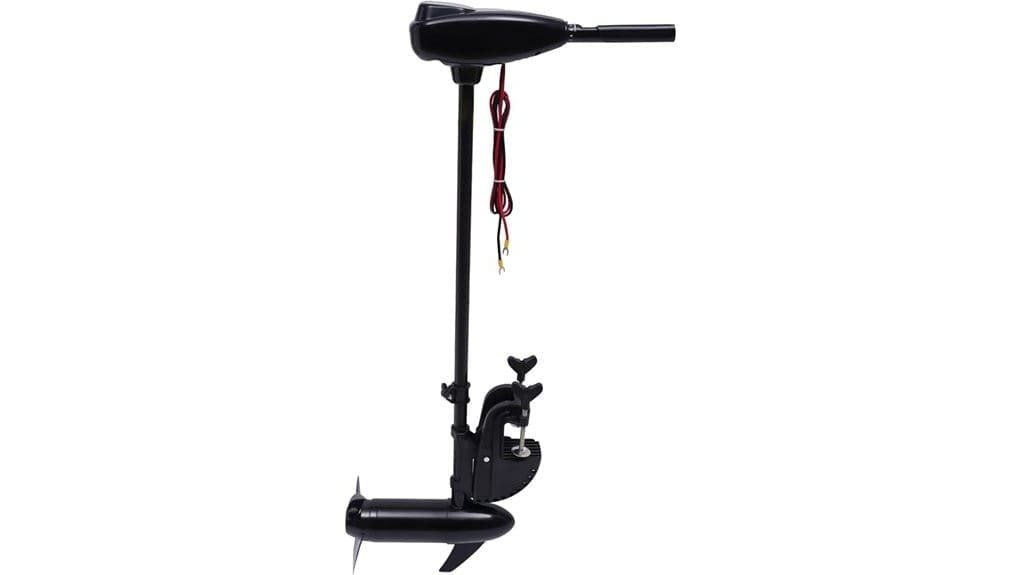
You’ll find this 12V 800W outboard gives about 80 lb thrust, compact and light enough for inflatables, kayaks, and small aluminum boats. It uses corrosion‑resistant alloys, a reinforced nylon transom bracket, and a glass‑fiber shaft for stiffness and low weight. Eight speeds, telescopic handle, and ten‑step angle let you tune thrust and ergonomics. Use 12V 30–120 AH batteries matched to your mission; maintenance is simple. Continue for detailed performance, installation, and battery guidance. The 80lbs kayak trolling motor features robust construction that ensures durability in various water conditions. Users will appreciate its quiet operation, which enhances the fishing experience without disturbing the environment. Additionally, the lightweight design makes it easy to transport and install on different types of kayaks and small boats.
Some Key Takeaways
- 12V 800W outboard delivers about 80 lb thrust, ideal for inflatables, kayaks, and small aluminum boats.
- Corrosion-resistant materials, reinforced nylon bracket, and glass-fiber shaft suit freshwater and nearshore saltwater use.
- Eight-speed control (five forward, three reverse) and telescopic handle provide ergonomic adjustment and mission-specific thrust.
- Recommended batteries: 12V 30–120 AH deep-cycle AGM or lithium—trade runtime, weight, and recharge cycles accordingly.
- Maintenance: rinse after salt exposure, inspect brushes/seals, torque mounts, and use marine-grade connectors to reduce corrosion.
Who Should Consider This 12V 800W Outboard and Why
Although it’s compact, this 12V 800W outboard delivers enough thrust and durability to suit a specific set of users: anglers and small-boat operators who need a lightweight, corrosion-resistant electric drive for freshwater or nearshore saltwater use. You’ll find it ideal if you’re a budget angler or a solo adventurer operating inflatables, kayaks, or small aluminum boats. The 80 lb thrust, all-copper brush motor, and reinforced nylon bracket balance weight and longevity. Eight-speed control and telescopic handle let you optimize propulsion and ergonomics. Match battery AH to mission profile; installation and maintenance remain straightforward and low-cost. This model is particularly well-suited for motor-ready fishing kayaks and beginner kayak enthusiasts looking to add reliable electric propulsion without heavy modification.
Hands-On Performance Summary: Thrust, Speed, Battery Range, and Real-World Use Cases
Start by testing thrust and speed under typical loads to set realistic expectations: the 800W, 80 lb (176 kg) unit produces adequate push for inflatables, kayaks, and small aluminum boats but won’t match full-sized outboards. You’ll perform controlled thrust testing at varying speeds and loads, recording no-load 1900 r/min and practical cruising RPM. Monitor battery endurance with recommended 12V 30–120 AH packs to map range against speed settings. Log noise levels and inspect prop wash patterns for cavitation or debris build-up. Results show competent low-speed thrust and efficient mid-range cruising, suitable for fishing, aquaculture, and light transport. Consider pairing the motor with appropriate anchor weights to ensure calm and confident kayaking when stationary.
Installation, Controls, and Adjustability: Mounting, Handle, Angle, and Operation Steps
When you mount and adjust the VONZOER 800W outboard, follow a systematic sequence to guarantee secure installation and reliable control: position the glass-fiber main pole into the transom bracket, clamp the reinforced-nylon mount tightly to avoid lateral play, and align the propeller shaft parallel to the hull centerline to minimize vibration. Next, verify mounting hardware torque and corrosion-free fasteners. Set the eight-speed controller and choose from five forward or three reverse gears for mission-specific thrust. Adjust the 10-step motor angle for maximum thrust vectoring. Confirm handle ergonomics and telescopic reach, then perform a staged power-up and seaworthy functional test. Also consider integrating a dedicated mounting bracket and gear tailored for kayak power pole setups to enhance stability and compatibility.
Build, Corrosion Resistance, and Durability: Materials, Wiring, Motor Type, and Maintenance Needs
After you verify mounting integrity and control operation, assess the build materials and corrosion protections that determine long-term durability. You’ll note a glass fiber composite main rod delivering composite longevity through high stiffness-to-weight and fatigue resistance. Aluminum components and a reinforced nylon bracket balance weight and seawater tolerance, but check fasteners for galvanic potential. The all-copper brush underwater motor system offers compact efficiency; inspect brushes and seals for wear. Prioritize wiring waterproofing: sealed all-copper cores and marine-grade connectors reduce corrosion risk. Establish a maintenance schedule: rinse after salt exposure, torque-check mounts, inspect seals, and replace worn brushes or connectors proactively. Consider adding a deck-mounted pump for quick bilge and deck water removal to complement motor maintenance and safety checks; see deck-mount pumps for options and compatibility.
Buying Checklist and Value Judgment: Recommended Batteries, Boat Sizes, Pros vs. Cons, and Final Recommendation
Evaluate battery capacity, boat size compatibility, and trade-offs before buying to guarantee the 12V 800W, 80 lb-thrust motor meets your mission profile. Choose 12V 30–120 AH batteries based on runtime vs weight; battery compatibility with deep-cycle AGM or lithium affects range and recharge cycles. Match to inflatable, aluminum, or wooden boats up to 6–8 people; smaller crafts need lighter batteries. Perform cost analysis including battery, mount, and maintenance tips like corrosion checks and prop inspection. Pros: compact, efficient, seaworthy materials. Cons: single 12V limits top speed. Final recommendation: suitable for anglers prioritizing quiet, efficient thrust; consider lithium for best resale value. Include essential safety gear like a personal locator beacon or PLB device when venturing offshore.
Some Questions Answered
Is the Propeller Compatible With Aftermarket Replacement Blades?
Yes — you can use aftermarket blades if they match the propeller fitment specifications. You’ll need to verify shaft diameter, hub design, blade count and mounting pattern; blade interchangeability isn’t universal. Measure the original prop hub and confirm bolt spacing, taper or spline type, and pitch to guarantee secure engagement and balance. If dimensions align and materials tolerate aquatic use, aftermarket blades will work; otherwise stick with OEM replacements to avoid vibration or failure. Trolling motor performance in deep water is critical for maintaining control and efficiency. Selecting the right blades can significantly impact your ability to navigate in challenging conditions. Additionally, regular maintenance and attention to detail will enhance overall performance and prolong the life of your motor.
Can I Use This Motor for Trolling in Strong Ocean Currents?
Yes — but expect limits. You can use it in strong ocean currents for short periods, yet 800W and 80 lb thrust may struggle against sustained high-flow conditions. You’ll see rapid battery drain as the motor works near maximum output; recommend high-capacity batteries (close to 120 AH) and reduced boat load. Monitor temperature and propeller fouling. For continuous heavy-current trolling, consider a higher-thrust or dual-motor solution. The 55lb thrust trolling motor features impressive efficiency for light-duty applications. It is designed to provide reliable maneuverability in smaller bodies of water. Users appreciate its quiet operation, which is perfect for fishing without disturbing the surroundings. Electric outboard motor performance review highlights the need for users to be aware of their equipment’s limitations. This type of motor can be effective in calm waters but may require more powerful alternatives in challenging conditions. It’s essential to evaluate the specific needs of your boating adventures to ensure optimal performance and safety.
Does the Unit Include a Circuit Breaker or Fuse?
No — the unit doesn’t include a circuit breaker or fuse. You’ll need to install a battery fuse and appropriate inline breaker between the battery and the motor. Verify the wiring harness gauge and connector type, then select a fuse/breaker rated slightly above the motor’s max current draw (800W at 12V ≈ 67A) to protect the harness and battery. Follow manufacturer wiring recommendations and marine electrical standards for safe installation. When considering a suitable setup for your fishing needs, happybuy trolling motor specifications can greatly influence your decision. It’s vital to ensure compatibility between the motor power and your boat’s capacity. Additionally, always check for the latest updates on specifications to get the best performance from your equipment.
What Is the Noise Level (dB) During Operation?
The manufacturer doesn’t specify a dB rating, so you can’t cite an exact noise level. Based on the all-copper brush motor and waterproof housing, expect moderate acoustic signature dominated by motor whine and propeller cavitation. You’ll measure both airborne noise and vibration transmission into the hull; vibration damping and mount stiffness will materially affect perceived loudness. For precise dB values, you should perform on-water tests with a calibrated sound level meter.
Are Spare Parts Available After the One-Year Warranty?
Yes — you can obtain spare parts after the one-year warranty. You’ll find availability options through the manufacturer VONZOER, authorized dealers, and third-party parts sourcing channels. Start with VONZOER support for OEM components; if unavailable, use reputable aftermarket suppliers for propellers, brackets, and electrical parts. Verify compatibility, corrosion-resistant materials, and return policies. Keep serial/model info and installation records to streamline parts sourcing and technical support.