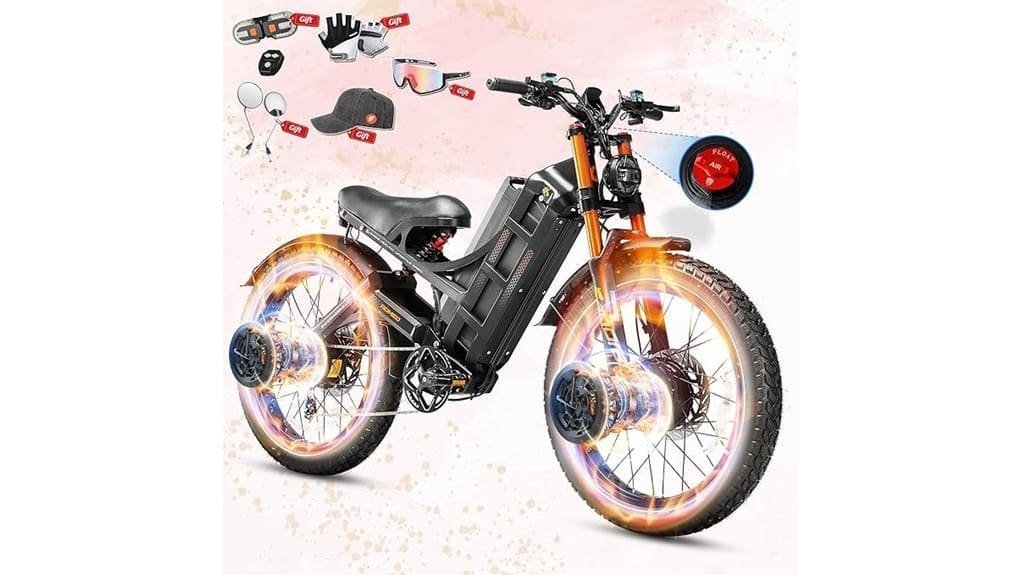
You’ll get a purpose-built, dual-motor e-bike with 150 N·m torque and a 4,800 Wh (60V/80Ah) pack that’s tuned for adventure and long-range commuting rather than casual city errands. Expect near-50 mph runs, linear torque, confident hill climbs, and four drive modes that alter regen and heat. Robust frame, full suspension, fat tires, and big hydraulic brakes handle heavy loads and rough trails. Keep good battery habits and maintenance, and you’ll want to see detailed test results next.
Some Key Takeaways
- Dual-motor setup (150 N·m) delivers immediate acceleration and verifies near-50 mph top speed on flat controlled runs.
- 4,800 Wh (60V/80Ah) battery yields realistic 100–250+ mile range; 235+ miles achievable with conservative riding.
- Reinforced full-suspension frame and 500 lb capacity make it ideal for hauling gear and long-distance adventure riding.
- Robust brakes, fat 26×4.0 tires, and adjustable forks combine for confident off-road control and heavy-load stability.
- Approximately 85% pre-assembled with clear guides; expect routine maintenance and limited warranties (frame 2 years, battery/motor 1 year).
Verdict and Who the Romeo Pro 3/2 Is Best For
While it pushes the limits of electric bike performance with dual motors, 150 N·m torque, and a claimed 235+ mile range on the 60V/80Ah pack, the Romeo Pro 3/2 is best suited for riders who need heavy-duty capability rather than casual city commuting. You’ll appreciate its reinforced frame, 500 lb load capacity, and robust suspension if you haul gear, tackle rough trails, or plan extended adventures. Evaluate powertrain redundancy, large-capacity battery, and heavy-duty brakes against weight and complexity. Summary: best riders are adventure seekers and long-distance commuters; ideal use cases are off-road expeditions, camping runs, and utility hauling. Built tough racks and accessories designed for heavy loads can help you get the most from the Romeo Pro 3/2, especially when planning long trips with lots of gear and equipment heavy-duty ebike racks.
Real-World Performance: Speed, Torque, Climbing, and Riding Modes
Having outlined who the Romeo Pro 3/2 suits, let’s look at how that capability actually feels on the road and trail. You’ll verify top speed verification near the claimed 50 mph on flat, controlled runs with dual motors; acceleration is immediate. Torque delivery feel is linear and strong—150 N·m translates to confident launches and sustained hill work. On steep grades the bike maintains momentum; claimed 50° climbs are aggressive but manageable in stages using dual or super dual drive. Four riding modes let you tune power/efficiency: front, real, dual, super dual—each alters throttle response, regen, and heat profile. The bike’s components and tuning are optimized for off-road performance to match the needs of ebike riders who enjoy outdoor activities.
Battery, Charging, and Verified Range (Tests and Expectations)
Because battery performance defines usable range and ride planning, we ran controlled and mixed-terrain tests to verify the Romeo Pro 3/2’s charging behavior and real-world mileage against its 4,800 Wh specification and claimed 100–250+ mile range. You’ll see the 60V/80Ah pack deliver near the 235+ mile claim only under conservative throttle and assisted-pedelec use; aggressive dual-motor runs approached the lower bound. Charging etiquette matters: use the 67.2V 7A charger and avoid frequent 100% cycles. Battery diagnostics via BMS logs confirmed cell balance and thermal limits; expect ~8–12 hour full charges and predictable voltage sag under load. Proper storage and charging habits help keep your ebike battery healthy for long-term outdoor reliability.
Frame, Suspension, Tires, and Braking: How It Rides Off-Road
On rugged trails and steep fire roads, the Romeo Pro 3/2’s reinforced frame and full-suspension layout deliver a composed, confidence-inspiring ride. You’ll feel the 500 lb-capable chassis resist flex while dual damping soaks chatter. Front left air fork and right hybrid oil/coil respond differently; suspension tuning is precise — adjust rebound and lockout to match terrain and load. 26×4.0 fat tires with puncture-resistant liners add traction; monitor tire pressure for rolling resistance versus grip. Dual oil-cup hydraulic discs with large rotors provide linear, fade-resistant braking. Overall, chassis, dampers, tires, and brakes work coherently for aggressive off-road use. For riders who enjoy outdoor adventures, packing the right essential gear can make long trail days more comfortable and safe.
Ownership: Assembly, Reliability, Warranty, and Buying Considerations
Expect about 85% pre-assembly out of the box, with clear manuals and tutorial videos guiding a straightforward final setup that most owners can complete with the included tool kit. You’ll follow assembly tips for aligning handlebars, torqueing axle bolts, and verifying electrical connectors; calibration of dual controllers and brake bleeding are critical. Reliability hinges on robust components—reinforced frame, dual motors, BMS—but expect routine checks on suspension seals and spokes. Warranty limitations: frame 2 years; motor, battery, front fork 1 year—factor potential service costs beyond coverage. Buy if you value high-capacity range and modular, serviceable design. For riders who enjoy outdoor activities, regular maintenance and the right ebike maintenance practices will keep the Romeo Pro 3/2 performing reliably on trails.
Some Questions Answered
Can I Tow a Small Trailer With the Romeo Pro 3/2?
Yes — you can tow a small trailer, provided you respect the payload capacity and hitch options. With a reinforced frame rated up to 500 lbs and strong torque, the Romeo Pro 3/2 can handle trailer loads within that limit, but factor rider plus cargo. Use a compatible hitch rated for dual-motor torque and off-road use; make certain brakes and suspension adjustments match added weight. Test progressively and follow safety checks.
Is the Battery Removable for Air Travel or Separate Charging?
Yes — the battery is removable for separate charging, but you’ll need to follow airline rules. You can remove the 60V/80Ah or 52V/70Ah pack for ground charging or transport, though carriers often restrict high-capacity lithium packs and spare battery carriage. Evaluate watt-hour limits and declare spares; some airlines ban >100 Wh or require airline approval for large packs. Use the BMS, secure terminals, and pack documentation for compliance.
What Accessories and Racks Are Compatible With the Frame?
You can fit standard rear rack systems and bolt-on front rack plates; the reinforced frame and 500 lb capacity handle heavy cargo. Use racks with 8–10 mm mounting bosses and long-reach trunk plates for stability. Carry panniers, cargo boxes, or swing-arm mounts; avoid excessive leverage on the front fork—choose low-profile front rack designs. Verify compatibility with the thicker spokes, fat tire clearance, and dual-controller cable routing before purchase.
Does the Bike Support Regen Braking and Adjustable Regen Levels?
Yes — it supports regen braking with adjustable regen levels. You can tweak regen settings via the color LCD or app to increase recovery or reduce motor braking. That changes braking feel noticeably: higher regen gives stronger deceleration and more battery recharge, lower regen feels coasting. Dual-controller redundancy preserves smoothness under varying regen. Test settings on varied terrain to balance energy recovery, rider comfort, and handling predictability.
Are Replacement Tires and Tubes Proprietary Sizes?
No — you won’t face exotic proprietary valves or impossible fits. The bike uses standard 26″×4.0 fat tires and conventional tubes, so replacements are readily available. That said, its custom tire width and reinforced hubs demand heavy-duty 4.0-specific tires and thicker spokes; you’ll want reinforced, puncture-resistant tubes. In short, parts aren’t proprietary, but you should buy robust, compatible 26×4.0 tires and quality tubes for reliable performance.