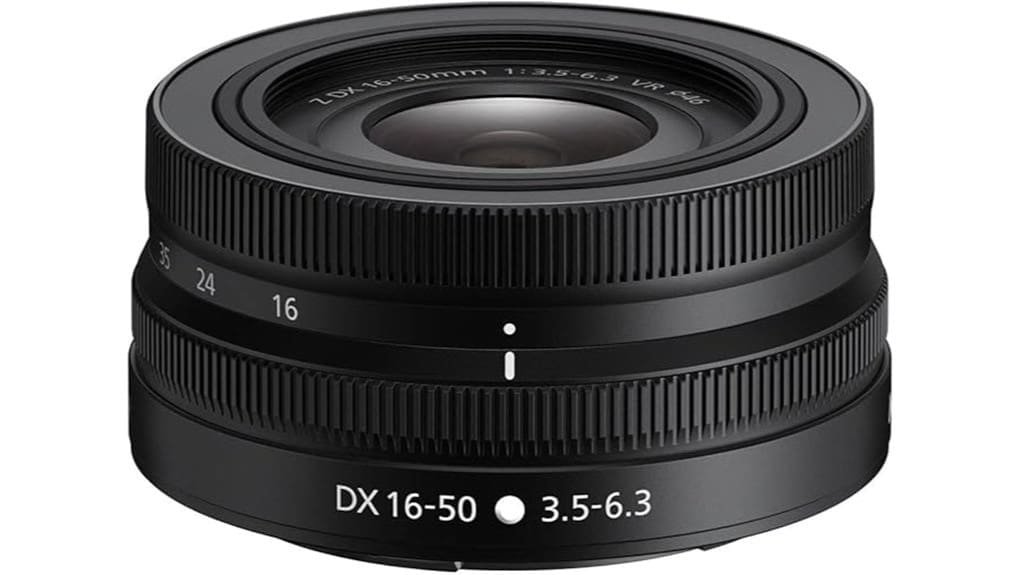
You’ll find the NIKKOR Z DX 16–50mm f/3.5–6.3 VR is a tiny, 135 g travel zoom that’s built for portability and stabilized handheld work. It gives strong center sharpness, useful 0.2 m close-focus, and about 4.5 stops of in-lens VR that pairs with body IS. AF is quick for everyday subjects and video, though edges soften wide and max aperture is modest. If you want compact, stabilized versatility, this review covers practical strengths and trade-offs.
Some Key Takeaways
- Compact 16–50mm Z DX zoom (24–75mm equiv) ideal for travel, vlogging, and everyday use due to its lightweight 135 g design.
- Good center sharpness across the range; edges soften wide but improve markedly by f/5.6–f/8 for fine detail.
- Close-focus to 0.2 m offers crisp macro-like detail and useful working distance for small subjects.
- In-lens VR provides about 4.5 stops of stabilization, with modes for stills and panning and compatibility with body IBIS.
- Fast, reliable AF and a silent control ring suit handheld video and quick shooting, though low-light AF can slow at tele end.
Quick Verdict and Who This Lens Is Best For
While compact enough to disappear in a camera bag, this 16–50mm Z DX zoom gives you a versatile wide-to-normal range (24–75mm equivalent) with close-focus ability and effective in-lens VR, so it’s ideal for travel shooters, vloggers, and everyday photographers who prioritize portability without sacrificing low-light performance or steady handheld video. You’ll get a lightweight 135 g package that balances size with functional control: a silent ring handles focus and exposure adjustments, and fast AF locks quickly. It suits budget travelers and beginner vloggers seeking an all-purpose, stabilized optic that minimizes gear burden while delivering reliable handling and performance. Perfect for mirrorless enthusiasts, it complements other essential gear for mirrorless camera users.
Real-World Image Quality: Sharpness, Bokeh, and Close-Up Performance
When you test the 16–50mm across its range you’ll find strong center sharpness from 16mm through 50mm, with edge performance that softens a touch at the widest setting but tightens up by f/5.6–f/8; detail resolution is very good for a compact DX zoom. You’ll get pleasing bokeh at longer focal lengths though background blur shows busy rendering from six rounded blades—smooth for small subjects, less so for busy highlights. Close-focus to 0.2 m delivers crisp detail and useful working distance. Color rendition is neutral with accurate saturation; edge rendition improves stopped down, giving more uniform microcontrast across the frame. This compact zoom is a handy choice for enthusiasts who prefer prime-like image quality in a portable package.
Stabilization, Low-Light Use, and Autofocus in Practical Shooting
Tap the in-lens VR and you’ll notice it lets you shoot handheld at substantially slower shutter speeds—roughly 4.5 stops of stabilization—so low-light handheld exposures and walking video stay usable without raising ISO excessively. You can switch stabilization modes for stills or panning; the VR pairs with body stabilization on compatible Z bodies to tighten results. In practical low light techniques, prioritize lower ISO, steady stance, and single-point AF for static subjects; use continuous AF for moving ones. Autofocus is brisk and reliable for everyday shooting but expect slower acquittal at the longest focal lengths and in very dim scenes. Many photographers pair these features with dedicated flash triggers to better control lighting in low-light situations.
Size, Controls, and Ergonomic Experience for Travel and Vlogging
Because it’s so compact and lightweight, you’ll comfortably carry the 16–50mm all day without it weighing down your kit, and the pancake profile makes it ideal for travel and gimbal-based vlogging rigs. At 135 g and retracted length, compact portability is a real advantage for street shooting and long walks. The silent control ring gives responsive, tactile controls for aperture, focus, or exposure compensation, suited to quick adjustments while recording. VR and fast AF mean you won’t need to agonize over every setting. Ergonomically, it balances well on Z DX bodies, minimizing fatigue during handheld shoots. It’s a great match for photographers who need a small, efficient setup for on-the-go shooting with camera backpacks.
How This Lens Compares and Whether to Buy (Alternatives and Value)
You’ve seen how the lens’s size, controls, and stabilization make it great for travel and vlogging; now let’s compare its optics, performance, and value against alternatives so you can decide if it fits your kit. Optically, the 16–50mm covers 24–75mm equiv. with competent sharpness and useful 0.2m close-focus; VR boosts low-light usability. Compared to faster kit primes and zooms, it trades aperture and edge resolution for portability and price. Consider third party alternatives if you need wider apertures or cheaper glass, but remember potential AF and support tradeoffs. For casual shooters prioritizing compactness, its long term value is strong. Perfect Tripods offers related gear for photographers looking to maximize stability and portability with compact lenses, including tripods and travel supports for tripod accessories.
Some Questions Answered
Is This Lens Weather-Sealed?
No, it isn’t fully weather-sealed. You won’t get extensive weather protection or robust dust resistance from this lens’ design. It’s built as an ultra-portable DX zoom with convenience features—VR, close-focus, silent control ring—but Nikon doesn’t rate it for full environmental sealing. You should avoid prolonged exposure to heavy moisture, sand, or dust; use caution in adverse conditions and consider protective measures like a rain cover or a better-sealed lens for harsh environments.
What Filter Thread Size Does It Use?
It uses a 52mm filter diameter, so you’ll fit 52mm filters and accessories. The front cap size matches that 52mm diameter, so you’ll use the standard 52mm snap-on front cap. Because the lens retracts, you should store filters separately when collapsing the lens to avoid contact. Using step-up rings or slim filters can help reduce vignetting at wider focal lengths while maintaining secure front cap protection.
Does It Support Full-Frame (FX) Cameras Natively?
No — it’s not full frame; it’s a DX lens and lacks native compatibility with FX sensor coverage. You can mount it on a Nikon Z full-frame (FX) camera, but the camera will automatically crop to DX mode or vignette severely if forced to use full-frame area. So you won’t get native full-frame field of view or full-sensor resolution; it’s designed natively for APS-C (DX) bodies for peak performance.
Is the Lens Compatible With Teleconverters?
No — you can’t use teleconverters with this lens. The small DX zoom and its electronic/silent control ring weren’t designed for TC coupling, so adding one would degrade AF, increase focus breathing, and likely cause mounting or communication issues. Optical coatings and VR are optimized for the native optical path; a teleconverter would alter transmission, contrast, and sharpness. For greater reach, you should choose a longer native Z lens or crop/extend in-camera or in post.
What Is the Warranty Period and Service Coverage?
You get a one-year warranty duration from Nikon in many regions; some countries offer longer manufacturer or retailer warranties, so check your local terms. The service coverage typically includes defects in materials and workmanship, with repair or replacement at Nikon’s discretion, excluding accidental damage, wear, or misuse. You’ll need proof of purchase for warranty service, and extended protection plans may be available through the retailer or third-party providers.