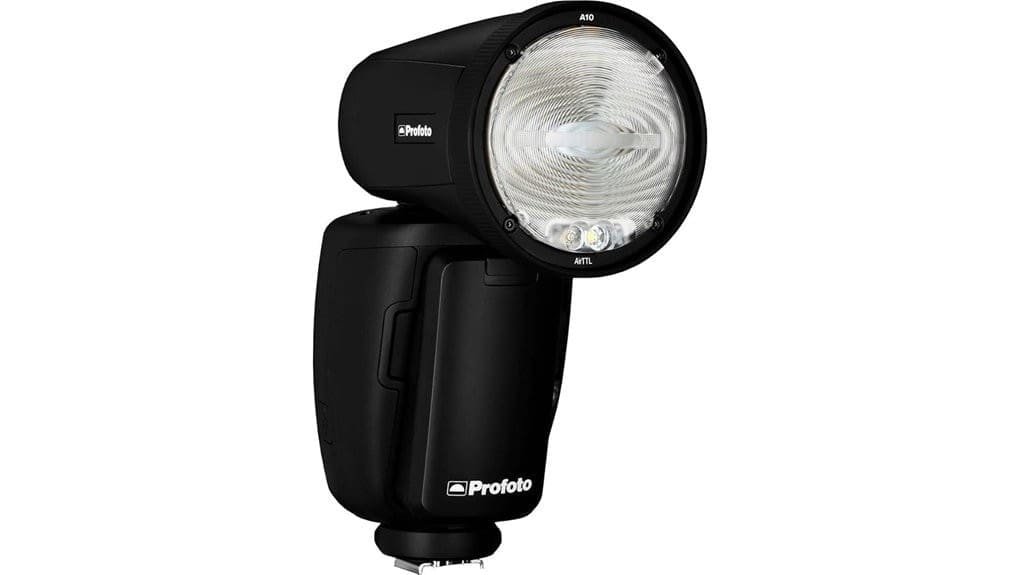
If you shoot portraits, weddings, or events on Canon gear and want a compact, studio‑quality on‑camera flash, the Profoto A10 gives reliable E‑TTL, HSS to 1/8000s, and about a 30 m guide number with fast ~1 s recycle times. Its exchangeable Li‑ion battery and robust controls suit pros, though thermal limits and lack of weather sealing matter for heavy bursts and outdoor use. Keep going and you’ll find deeper hands‑on notes and alternatives.
Some Key Takeaways
- Compact, pro‑grade on‑camera flash with native Canon E‑TTL and AirX Bluetooth for fast setup and reliable triggering.
- High output (GN ~30 m / 100 ft), 1/1–1/256 power, 1s recycle, and HSS to 1/8000s for wide shooting flexibility.
- Excellent, natural light quality with smooth fall‑off, controlled specular highlights, and neutral 5600K modeling lamp.
- Robust build and intuitive controls; head tilt/rotation are smooth but weight affects camera balance and no weather sealing.
- Premium price but strong resale value; consider Godox or Canon alternatives if budget or ecosystem compatibility is priority.
What the Profoto A10 for Canon Is and Who It’s For
Meet the Profoto A10 for Canon: a compact, on‑camera flash built for professionals and serious enthusiasts who demand fast, reliable TTL and high‑speed sync performance on Canon bodies. You’ll find a precision tool that pairs seamless Canon E‑TTL control with AirX Bluetooth for quick setups. It’s aimed at pro shooters who need consistent color and repeatable output during portrait assistants’ handoffs and tight wedding coverage runs. You’ll appreciate the robust build, clear interface, and flexible head tilt/rotation, though it skips weather sealing. Expect studio-quality light shaping on camera, but be critical about relying on it as your sole lighting system. This is ideal for photographers looking to brighten photos with a compact, reliable on-camera lighting solution.
Key Specs That Matter: Power, Battery, and Sync Performance
While you’ll notice its compact body, the A10 packs serious output and fast electronics: a 100 ft/30 m guide number with a 1/1–1/256 power range gives you full-strength punch or fine-grained control for fill, and its exchangeable Li‑Ion battery supports roughly one second recycle times and a practical multi‑year lifespan. You’ll appreciate predictable exposure steps and a tight energy envelope, but monitor Battery health — capacity will drop after typical two‑year use. Sync modes are robust: native high‑speed sync to 1/8000 and reliable AirX/Bluetooth triggering. Critically, thermal limits and battery drain constrain sustained burst performance. For tethered studio setups, consider adding robust flash sync cables to ensure reliable connections and consistent triggering.
Real-World Use: TTL, HSS, Zoom, and Handling on a Canon Camera
Having established its power and sync chops, you’ll notice how the A10’s TTL and HSS behaviors affect day‑to‑day shooting on a Canon body. You’ll get reliable E‑TTL exposure most of the time; it’s conservative, so expect occasional front‑ or back‑lighting tweaks in mixed scenes. HSS is robust up to 1/8000s, letting you shoot wide open in bright conditions without shutterspeed compromises. Auto/manual zoom reacts quickly; the modeling light aids framing. Handling is professional: the head tilts/rotates smoothly, supporting on camera bouncing, though weight shifts the balance. The menu’s quick menu navigation is logical but can be fiddly with gloves. This makes the A10 a strong companion for photographers who use wireless flash triggers to master off‑camera lighting.
Image Quality and Lighting Behavior: Natural Light, Fall-Off, and Modeling
Because the A10 blends a high guide number with a refined reflector design, you’ll see very natural-looking light with smooth fall-off across a range of distances and lens focal lengths. You get controlled soft gradients on faces and backgrounds, with minimal harsh edges. Specular highlights remain well-defined without blooming, preserving texture in skin and materials. Shadow gradations are gradual and predictable, aiding quick exposure decisions in mixed lighting. The LED modeling lamp helps previsualize spread and angle. Color fidelity stays neutral at 5600K, though slight metering tweaks may be needed for mixed ambient sources. Overall: precise, consistent, workmanlike. This makes it an excellent match for photographers who use reflectors to shape and refine light.
Should You Buy It? Value, Alternatives, and Final Recommendation
The A10’s dependable, natural-looking output and fast recycle times make it a strong contender for on-camera work, but whether you should buy it depends on what you shoot and budget for. You’ll get professional-grade TTL, HSS, robust build, and Bluetooth control—useful for event, portrait, and hybrid shooters who need reliability and speed. Downsides: premium price and no weather sealing. For strict cost effectiveness, consider Godox or Canon’s OEM flashes; they offer similar features at lower cost but with trade-offs in build and ecosystem. If you value durability and solid resale value, the A10’s worth the investment. Mastering flash triggers and related accessories can further improve your results, especially when learning about flash triggers.
Some Questions Answered
Is the Profoto A10 Weather-Sealed for Outdoor Rain Use?
No — it isn’t weather-sealed for rain use. You shouldn’t rely on water resistance or expect built-in weather protection for outdoor shoots. The A10 is robust and professionally styled, but lacks official sealing against moisture, so exposure to rain risks damage. You’ll need external rain covers, protective housings, or shoot under shelter to maintain reliability. Treat it as non-weatherproof gear and plan contingencies for wet conditions.
Can the A10 Trigger Off-Camera Profoto Lights?
Yes — you can. You’ll get TTL triggering to off-camera Profoto lights via built-in AirX Bluetooth and Profoto Air compatibility, enabling Canon E-TTL commands and HSS remotely. It’s reliable for TTL triggering and manual control but depends on AirX range and line-of-sight; expect occasional latency or sync limits in complex scenes. For critical multi-light setups you’ll likely want a dedicated Air transmitter or tethered radio system for maximum robustness.
What Accessories Are Included in the Box?
The box includes the A10 head, a spare battery, a charger, a diffuser cap, and a hot‑shoe mount. You’ll also get a protective pouch, USB‑C cable, quick‑start guide and warranty card. It won’t include light stands, sync cables, or off‑camera triggers as standard. You’ll appreciate the spare battery for extended shoots and the diffuser cap for softer output, but you’ll likely need extra accessories for multi‑light setups.
Does the Flash Support Canon Mirrorless Adapter Compatibility?
Yes — you can use a mount adapter to fit Canon mirrorless bodies, but you’ll want to verify firmware compatibility first. The A10’s hot shoe communication and E-TTL/HSS functions depend on matching firmware and proper electronic contacts; older adapters or mismatched firmware can break TTL or HSS. Use Canon-approved or Profoto-recommended adapters and update the flash firmware to guarantee reliable exposure control, sync and AF-assist performance.
How Long Is Official Warranty Coverage Beyond One Year?
There isn’t official warranty coverage beyond the 1 Year Limited Warranty; you’re limited to that period unless you purchase extended protection. If you want longer coverage, you’ll need to buy a third-party or manufacturer-offered extended protection plan where available. Check Profoto or authorized dealers for specific extended plan durations, terms, and exclusions; they’ll spell out service, parts, and labor limitations versus the original limited warranty.