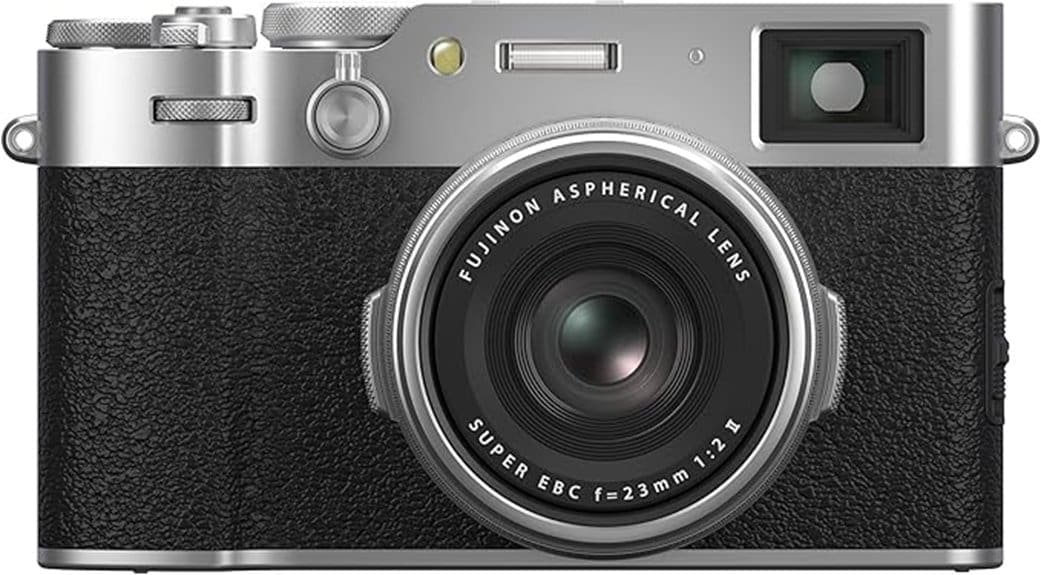
You’ll get a compact rangefinder with a 40.2MP APS‑H X‑Trans CMOS 5 sensor, fixed 23mm f/2 lens, IBIS up to 6 stops and 425‑point hybrid AF for rapid acquisition and reliable tracking. It shoots 14‑bit RAW, offers strong microcontrast and Film Simulations for faithful color, and records 6.2K/4.3K video with clean HDMI output. Battery, USB‑C charging and wireless workflows make it travel‑ready — keep going to see strengths, limits and ideal use cases.
Some Key Takeaways
- Compact APS-H 40.2MP sensor with X-Processor 5 delivers high-resolution files and excellent dynamic range for stills and RAW editing.
- Fixed 23mm f/2 lens with 1x/1.4x/2x teleconverters suits street, travel, and environmental portrait work.
- 425-point Intelligent Hybrid AF and IBIS (up to 6 stops) enable fast acquisition and steady handheld shooting.
- 6.2K/30p and 4.3K video, USB-C/HDMI outputs, and Frame.io support make it strong for hybrid photo‑video workflows.
- Classic rangefinder design with dedicated dials, tilting touchscreen, and Film Simulations offers tactile control and reliable color out of camera.
What the X100VI Silver Is : Core Specs That Matter to Buyers
Although it keeps the classic rangefinder silhouette, the X100VI Silver brings a seriously modern core: a 40.2 MP APS-H X-Trans CMOS 5 HR sensor paired with the X-Processor 5, 14-bit RAW support, and IBIS with up to 6 stops of stabilization. You’ll find a fixed 23mm f/2 optic, 1x/1.4x/2x teleconverter modes, and a 1/180000s shutter ceiling for fast action. The body balances compact aesthetics with robust tactile controls: dedicated dials, programmable function buttons, and a tilting 3″ touchscreen. Connectivity includes USB, HDMI, Wi‑Fi, Bluetooth, and Frame.io cloud integration for streamlined workflows. This model is well-suited for mirrorless camera enthusiasts who appreciate essential gear that complements compact, high-performance bodies.
How Image Quality Performs: Sensor, Lens, RAW & Film Simulations
When you push the X100VI’s 40.2 MP APS-H X-Trans CMOS 5 HR sensor and X-Processor 5 to work, you get exceptionally high-resolution files with tight noise control thanks to the 14-bit readout and Fujifilm’s refined demosaic algorithms; fine detail and tonal gradation remain strong up to normal and expanded ISO ranges, and IBIS helps preserve micro-detail at slower shutter speeds. You’ll see high resolution rendering across the frame, aided by the 23mm optic’s lens microcontrast that separates textures. RAW retains latitude for exposure and color grading, Film Simulations give reliable color fidelity, and overall noise performance is excellent. For photographers striving for accurate on-screen results, calibrating your display with monitor calibration tools ensures those high-resolution files are viewed with true-to-life color.
Autofocus, Speed, and Handling in Real-World Shooting
If you push the X100VI into fast-paced scenarios, its 425-point Intelligent Hybrid AF with deep-learning subject detection and AF-C keeps subjects locked with impressive consistency, even at wide apertures and high resolution. You’ll rely on dense phase detection pixels for rapid initial acquisition, while AI improves prediction for erratic motion. Continuous shooting to 30 fps pairs with a responsive mechanical/electronic shutter interface so frame timing stays precise. Handling is compact and tactile: aperture ring, function dials, and a textured grip let you operate instinctively. Touch tracking on the tilting LCD provides reliable recompose-and-follow performance for run-and-gun work. For photographers who prefer stabilized handheld movement, pairing the camera with a handheld gimbal can significantly improve footage smoothness.
Video, Stabilization, Battery Life, and Connectivity for Hybrid Shooters
Because Fujifilm built the X100VI as a true hybrid, you get substantial video capability paired with reliable stabilization and modern connectivity for on-the-go workflows. You can record up to 6.2K/30p and 4.3K movie modes with 14-bit still capture continuity, and the HDMI/USB ports support clean output and external recorders. Sensor-shift IBIS delivers up to 6.0 stops of stabilization, aiding handheld pans and time-lapses. Battery optimization features include USB-C charging and power-saving modes to extend runtime during long shoots. Integrated Bluetooth, Wi‑Fi, and Frame.io Camera to Cloud support fast wireless workflows for immediate delivery. For photographers who prefer cloud backups, choosing the right cloud storage plan helps secure and sync your photos across devices.
Who Should Buy the X100VI Silver : Use Cases, Alternatives, and Value Comparison
Who exactly benefits most from the X100VI Silver? You’ll appreciate its 40.2MP APS-H sensor, 23mm f/2 lens, IBIS up to 6 stops, and 425-point AF for precise street photography and a travel compact kit that’s technically potent. If you shoot portrait intimate work, its lens character, 14-bit RAW and Film Simulations deliver tonal control. Alternatives include full-frame mirrorless for shallow depth or zoom-ready compacts for reach; consider X-T series bodies with zooms. For the enthusiast collector, build, limited finish and hybrid video (6.2K/30p) justify premium value versus generic compacts. Many shooters pair such cameras with external camera monitors to improve framing and focus when working in varied lighting and angles.
Some Questions Answered
Does the X100VI Support Vertical Battery Grips or External Power Packs?
No, the X100VI doesn’t support a dedicated vertical grip, and it lacks a proprietary vertical grip accessory. You can use external batteries or power packs via the USB-C port for extended runtime, but there’s no formal battery-grip interface or contacts. If you attach external batteries, you’ll rely on third-party USB-C power banks or dummy battery solutions; expect limited official support, so verify voltage, PD compatibility, and charging/pass-through behavior before use.
Can I Use Third-Party Lenses or Adaptors With the Fixed Lens?
No, you can’t mount interchangeable lenses; the fixed 23mm optic is integral, so you won’t use standard lens adapters to swap glass. You can, however, employ filter adapters and certain lens adapters that attach to the front thread (49 mm) to add screw-on converters, close-up lenses, or specialty optics. Those adapters change field of view or close-focus but won’t provide full electronic control, autofocus integration, or native IBIS optimization with third-party lenses.
Is the Camera Weather-Sealed for Use in Rain or Dusty Conditions?
No — the camera doesn’t have full weather sealing, so you shouldn’t rely on it in heavy rain or sandstorms. You’ll want to treat its dust resistance? and weather sealing? as limited; Fujifilm lists a compact, rangefinder-style body with no IP rating and only basic protection. You can use light drizzle with care, keep ports closed, and add a rain cover or external protection for reliable shooting in wet or dusty conditions.
Are Custom Color Profiles or LUTS Exportable From In-Camera Film Simulations?
No — you can’t directly export custom color profiles or LUTs from in-camera film simulations. You’ll retain Color Consistency across JPEG/HEIF outputs and embedded metadata, but Export Limitations prevent producing standardized LUT files from the camera’s internal Film Simulation engine. You’ll need to replicate simulations in post using reference RAW files, color charts, or third-party software to create LUTs, ensuring technical fidelity and predictable color workflows despite the camera’s output constraints.
Does It Support Tethered Shooting With Both Mac and Windows via USB?
Yes — you can USB tethering with the camera, and it offers cross platform compatibility. You’ll connect via the USB port to Fujifilm’s tethering/software or supported third‑party apps; macOS and Windows are both supported for live view, remote capture, and file transfer. Expect driver/firmware updates and app settings to enable full functionality, and verify USB mode and permissions on your OS for stable, low‑latency tethered shooting.