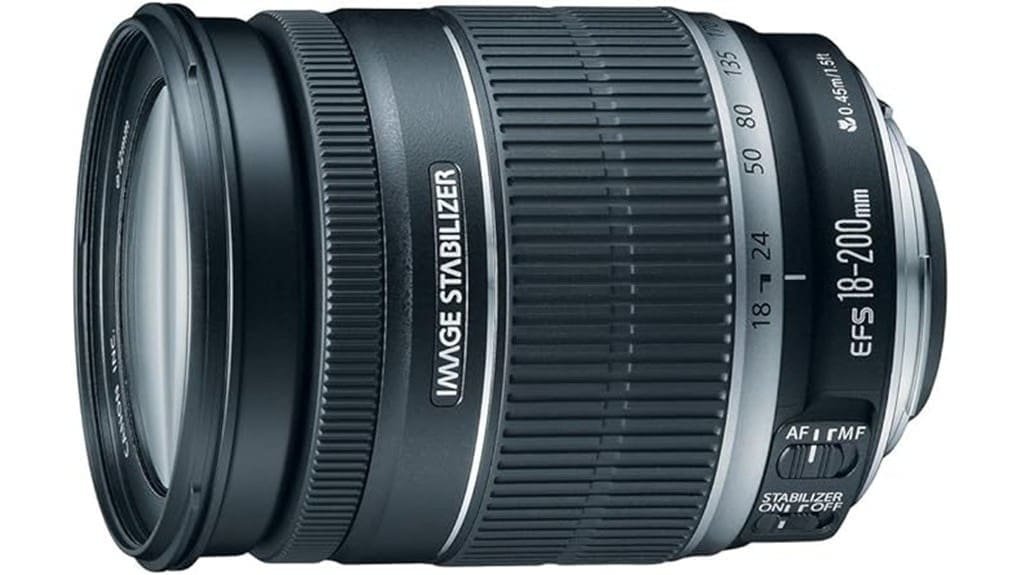
You’ll find the Canon EF-S 18–200mm f/3.5–5.6 IS a versatile, compact all-in-one zoom for APS‑C bodies that gives 28.8–320mm equivalent reach with up to four stops of optical stabilization. You’ll trade some edge sharpness, slower micromotor AF and limited low‑light performance for convenience and weight savings. It’s strong for travel and casual telephoto use but not for pro-grade portraits or fast action. Keep going and you’ll get specifics on optics, AF behavior, and practical alternatives.
Some Key Takeaways
- Versatile 18–200mm EF-S zoom (28.8–320mm equivalent on APS-C) covers wide-angle to telephoto in one compact lens.
- Variable f/3.5–5.6 limits low-light performance and subject isolation compared with fast primes.
- Optical IS provides up to four stops of stabilization, effective for handheld telephoto and slower shutter speeds.
- Micromotor AF is accurate in good light but noticeably slower and noisier than USM systems.
- Good center sharpness stopped down; corners and telephoto-end detail soften, with some chromatic aberration.
Quick Verdict: Who the 18–200mm IS Is Best For
If you want one do-it-all lens for travel and everyday shooting, the Canon EF-S 18–200mm f/3.5–5.6 IS (Renewed) delivers a compact, lightweight solution with an 11× zoom that covers wide-angle to telephoto on APS-C bodies (28.8–320mm equivalent). You’ll appreciate its broad focal range and optical IS if you’re balancing weight and versatility. Travel photographers who need rapid framing changes will favor it over multiple primes; casual shooters get simplified kit and fewer lens swaps. Expect middling low-light aperture and micromotor AF limits compared with pro zooms, but overall it’s a pragmatic, all-purpose choice. It pairs particularly well with a good tripod for stability during telephoto shots and long exposures.
Key Specifications and Compatibility at a Glance
While the 18–200mm IS looks like a single do-it-all optic, its specs reveal clear trade-offs you should weigh: it’s an EF-S mount zoom for Canon APS-C bodies (28.8–320mm equivalent) with an 11.11× range, a variable f/3.5–5.6 aperture, and optical IS rated up to four stops. You get compact, lightweight coverage from 18–200mm with micromotor AF and Super Spectra coatings, but variable maximum aperture limits low-light reach and depth-control compared to primes. Check mount compatibility — EF-S only (no full-frame). Practical details: 72mm filter sizes, 0.45m close focus, 0.24× magnification. For photographers concerned about workflow and storage, remember to choose the right SD card speed to match your shooting needs.
Image Quality, Autofocus, and Stabilization in Real-World Use
Digging into real-world performance, you’ll find the 18–200mm delivers competent but unsurprising results: sharpness is good in the center at most focal lengths stopped down a stop or two, but corner resolution softens noticeably—especially toward 200mm—so expect falloff compared with prime or higher-grade zoom optics. Contrast and microcontrast are adequate; Super Spectra coatings help control flare but residual chromatic aberration appears at high-contrast edges, particularly wide-open and near the long end. Autofocus is functional but driven by a micromotor—it’s accurate in good light, slower and louder than USM systems. Optical IS provides up to four stops of usable stabilization. Bokeh quality is acceptable for casual use. This makes the lens a practical choice for enthusiasts who want reach without the weight and cost of professional telephotos and a good overview of telephoto lens use in wildlife and sports photography.
Strengths and Limitations by Shooting Scenario (Travel, Portraits, Telephoto)
Because it packs an 11× zoom into a compact, lightweight package, the EF-S 18–200mm is a practical travel lens: you’ll cover wide-angle landscapes through long telephoto without changing glass, benefit from Optical IS for handheld shots, and carry less gear overall. For travel you’ll value reach, IS, and build durability, though corner sharpness and low light performance at long focal lengths lag fast primes. For portraits you’ll get usable bokeh quality at longer focal lengths but limited subject isolation at f/5.6 and some chromatic aberration on high-contrast edges. For telephoto work it’s versatile but not specialist-grade. It’s especially well-suited to photographers who prioritize portability and flexibility for travel photography.
Value, Alternatives, and Final Buy Recommendation
Although it’s not a specialist optic, the renewed Canon EF-S 18–200mm f/3.5–5.6 IS delivers strong value for shooters who prioritize versatility and light travel weight over ultimate image quality. You get broad focal coverage, usable IS, and compact handling at a bargain renewed price. In price comparison it’s competitive versus buying multiple primes or newer stabilized zooms. Check user testimonials for consistent AF and acceptable sharpness center-to-midframe. Consider long term durability given micromotor AF and limited warranty; inspect condition. If you want one-lens convenience and decent resale value later, buy renewed; pros needing top optics should choose alternatives. For photographers who use tripods, pairing this lens with a quality ball head can improve handling and framing stability.
Some Questions Answered
Does This Lens Work on Full-Frame Canon Bodies?
No — you can’t use this EF‑S lens on full‑frame Canon bodies without issues. The lens’s image circle is sized for APS‑C sensors, so on a full‑frame body you’ll get heavy vignetting or an unusable frame. With the crop factor of 1.6x on APS‑C, its 18–200mm behaves like about 28.8–320mm; on full‑frame that equivalence doesn’t apply and optical coverage fails. You’d need an EF or adapter solution.
Is the Warranty Extendable Beyond 90 Days?
No, the standard 90-day limited warranty isn’t automatically extendable by Canon; warranty transferability and extended protection depend on seller or retailer offerings. You’ll need to check the renewed-item seller’s policy or third-party protection plans for extended protection and transferable terms. Compare vendor warranties and credit-card or marketplace protection options; choose a plan that documents transferability and covers defects beyond 90 days to match your risk tolerance and resale goals.
Can It Accept Teleconverters for More Reach?
No — you can’t reliably use teleconverters with this lens; teleconverter compatibility is limited because it’s an EF-S zoom with a micromotor AF and a recessed rear element. If you force one, you’ll face significant image quality tradeoffs: reduced sharpness, lower contrast, and slower autofocus or AF loss. Compared to native longer glass, you’ll get worse performance and less stabilization benefit, so using a dedicated tele lens or extender-compatible EF telephoto is preferable.
Is the Front Element Rotating During Focusing?
No — the front rotation isn’t significant during focusing. You’ll notice the focus mechanism uses a micromotor AF that drives internal elements, so the front element stays mostly stationary compared with older extending designs. Compared to some lenses with rotating front groups (useful for screw-on polarizers), this one maintains front stability, making filter work easier. Expect minimal front rotation only from slight internal coupling, not full external rotation.
Are Replacement Lens Caps and Hoods Included?
No — replacement lens caps and hoods aren’t included with the renewed item; you’ll need to source aftermarket caps and third party hoods. You’ll find aftermarket caps that fit the 72 mm filter thread and third party hoods compatible with the 18–200mm profile. Compare build quality, fit, and bayonet vs. screw mount options. Expect tradeoffs: cheaper caps/hoods cost less but may sit looser or vignette at wide angles.