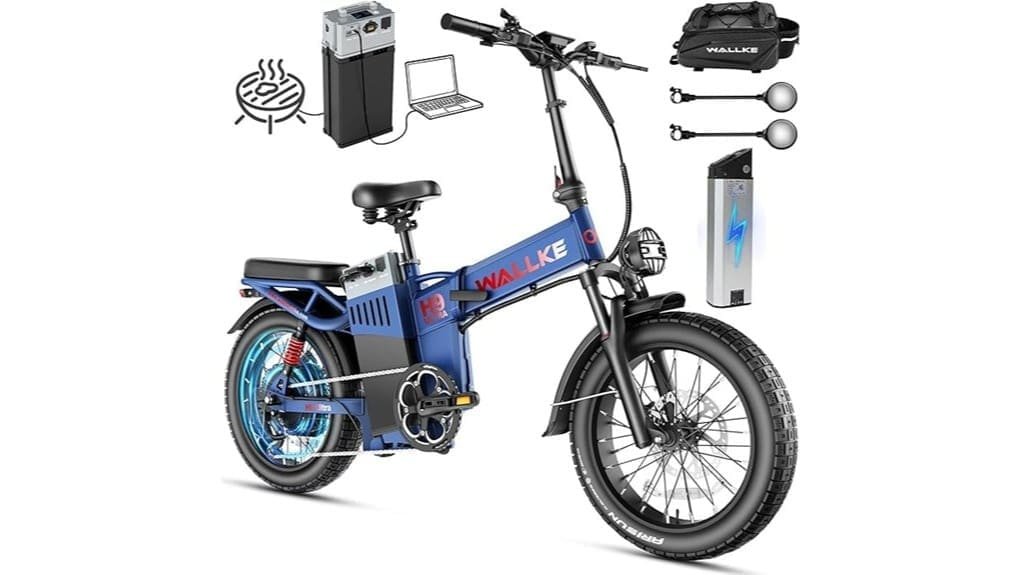
You’ll get a brutally powerful, long‑range cargo e‑bike that doubles as a portable power station, built for heavy commuters and adventure riders who need torque, payload capacity, and reliable stopping power. Its 2,640 Wh removable battery, 2,000W continuous (5,000W peak) motor, torque‑sensor PAS, and 203 mm 4‑piston brakes handle sustained loads but add weight and heat under hard use. It’s not nimble in tight urban traffic, and trade‑offs are worth inspecting further if you care about specifics.
Some Key Takeaways
- Heavy-duty e-bike with a single 2000W continuous (5000W peak) motor delivering strong, controlled acceleration and sustained high-speed performance.
- Massive 2,640 Wh removable battery (48V 55Ah) supports 70–120 mile typical range and doubles as a 600W portable power station.
- Torque-sensor PAS and 7-speed derailleur provide smooth, efficient pedaling and predictable gear shifts under high load.
- Aircraft-grade aluminum frame, robust suspension, 20×4 fat tires, and 203 mm 4-piston hydraulic brakes suit heavy loads and rough trails.
- Trade-offs include significant weight, size, and price, making it less ideal for nimble urban commuting despite excellent utility and range.
Quick Verdict: Who the Wallke H9 Ultra 5000W Is Best For
If you need a heavy-duty, long-range e-bike that doubles as a portable power station, the Wallke H9 Ultra 5000W is built for you. You’ll appreciate its robust frame, high-torque motor, and removable battery when you haul gear or power tools. It’s ideal for commuter adventurers who switch between city streets and rough trails, and for heavy commuters who need payload capacity and consistent stopping power. Expect professional gearing, torque-sensor efficiency, and durable components, but accept trade-offs: weight, size, and price limit nimble urban use. Choose this if payload, range, and utility outrank lightness. Consider pairing it with heavy-duty racks for secure transport and added utility.
Power, Range, and Battery-as-Portable-Station Breakdown
While the H9 Ultra reads like an e-bike first and a power station second, its 2,640 Wh removable battery (48V 55Ah) and optional 22Ah front pack make the bike a legitimate off-grid power source as well as a long-range drivetrain. You get 600W AC/DC output, AC/USB/Type-C ports and an 8.2 ft AC cable for tools or camping gear. Expect 70–120 miles typical, up to 180 miles in PAS mode; torque-sensor efficiency helps. Removable battery charges via AC or solar charging in about 6–8 hours. Battery versatility is strong, but weight and recharge logistics limit pure utility-station use. This makes it a compelling option for riders who prioritize extended range and long-range batteries for outdoor adventures.
Motor, Drivetrain, and Real-World Performance Tests
Because the H9 Ultra pairs a single 2000W continuous (5000W peak) motor with a torque-sensor-equipped PAS and a 7-speed derailleur, you’ll get predictable, high-torque performance without the twitchiness common to speed-sensor systems. You feel immediate, controlled thrust—high torque startups are firm but modulated by the torque sensor, so wheelspin is minimal. Cadence sensor dynamics remain secondary; the torque sensor prioritizes applied force, improving efficiency and ride feel. Gear shifts are crisp under load, 0–35 mph in ≈9 seconds. Critically, single-motor simplicity reduces failure points, but sustained high-speed runs heat the controller noticeably. This setup is ideal for riders who want to Boost Your Off-Road Thrills with high-performance ebike motors during outdoor adventures.
Build, Suspension, Brakes, and Off-Road Durability
Look closely at the H9 Ultra’s chassis and you’ll see an aircraft-grade 3 mm aluminum frame that’s built to take heavy loads and resist corrosion while folding down in about a minute for transport. You’ll note frame durability in weld quality and thickness; there’s minimal flex under 400 lb load. Suspension tuning is competent: adjustable air fork and dual rear shocks absorb big hits but need precise preload setup for aggressive trails. Braking reliability comes from 203 mm 4-piston hydraulics—consistent fade resistance under load. Offroad traction relies on 20×4 ARISUN fat tires; expect excellent grip, occasional weight-induced squirm on loose sand. The H9 Ultra pairs well with essential trail gear like a helmet and repair kit for mountain e-bike riders, emphasizing essential gear for safe off-road adventures.
Ownership Costs, Warranty, and Final Buying Recommendation
If you plan to keep the H9 Ultra long-term, factor in predictable service items and a strong warranty into your total cost of ownership. You’ll face routine wear: tire and brake replacements, drivetrain tuning, suspension seals, and eventual battery replacement—these drive long term costs more than initial price. The included one-year warranty plus claimed lifetime technical support helps, but verify battery and motor coverage; consider extended warranties for high-mileage use. If you need heavy-duty range, camping power, or delivery reliability, the H9’s robust build justifies the investment. Buy it if you prioritize power and serviceable components over minimal upfront cost. For outdoor riders who need dependable spare power, consider replacement options and accessories designed for off-road batteries to maintain performance on long trips.
Some Questions Answered
Can the Removable Battery Be Flight-Checked for Air Travel?
No — you can’t flight-check that removable battery as-is. Its 2640Wh capacity far exceeds typical battery compliance limits for airline policies (usually 100–160Wh for carry-on with airline approval). You’ll need to contact the airline and comply with dangerous-goods rules; expect refusal or requirement to transport via cargo under special permits. Don’t assume UL certification overrides watt-hour caps — airlines enforce stricter regulatory caps for passenger aircraft.
Is Theft Recovery or GPS Tracking Included or Compatible?
No—GPS tracking or theft recovery aren’t built in, but you can add third‑party modules. You’ll want anti theft upgrades like GPS trackers, immobilizers, and keyed/SmartLock options; installation’s straightforward to the removable battery compartment or frame. Note many trackers require cellular service and subscription services for real‑time alerts and recovery support. Evaluate power draw, mounting security, and carrier coverage before buying to avoid false alarms or drained batteries.
How Loud Is the Motor at Top Speed in Decibels?
You’ll hear motor noise around 70–75 dB at top speed. That peak sound sits near city traffic levels, so use a decibel comparison to judge: it’s louder than a normal conversation (60 dB) but below a motorcycle (85+ dB). You’ll notice reduced riding comfort during sustained high-speed runs, especially without ear protection. The noise is mechanical and consistent; consider torque-sensor tuning or insulation mods to improve comfort and lower perceived peak.
Are Spare Parts and Service Centers Available Nationwide?
Yes — you’ll find dealer network coverage and solid parts availability in major regions, but it’s uneven. Dealers handle common components (batteries, brakes, suspension, motors) and offer service; remote areas may face delays for specialty items. You should confirm local dealer inventory and turnaround times before buying. Expect faster support in urban centers, longer lead times for rare parts; warranty service is centralized, so shipping may be required for complex repairs.
Can the Bike Be Legally Registered as a Moped in the US?
You can, but it depends on state rules: if the bike exceeds local speed limits for e-bikes (often 20–30 mph) or has 2000W+ continuous power, many states classify it as a moped or motorcycle. You’ll need to meet licensing requirements, carry insurance, and pay registration fees. Expect higher insurance costs and variable registration fees across states; verify your DMV for exact thresholds, paperwork, and safety/equipment mandates before attempting registration.