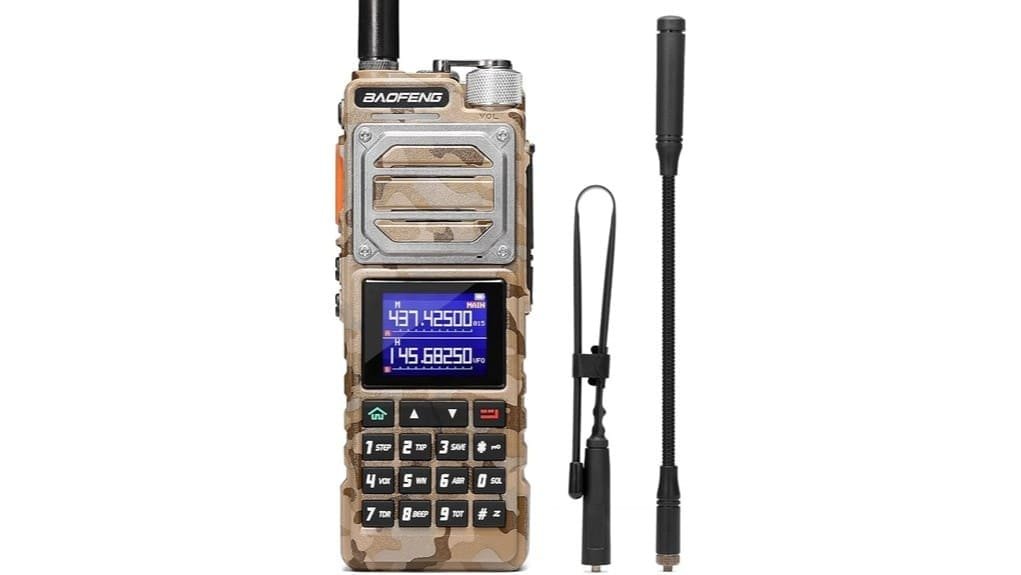
You’ll get a rugged, budget-friendly 10W dual-band handheld with long runtime and flexible power control (10W/8W/5W). It handles VHF/UHF and wideband receive (airband, NOAA), stores up to 999 channels, and’s CHIRP-compatible for easy programming. Metal housing, USB-C charging, a 5200mAh battery, and a top SOS flashlight favor outdoor use, though water resistance is limited. If you want more on range, performance, and alternatives, keep going for details.
Some Key Takeaways
- Rugged, budget-friendly dual-band handheld with metal housing and long-lasting 5200mAh battery.
- Tri-power transmit (10W/8W/5W) balances range versus battery life for flexible field use.
- Wideband receive covers VHF/UHF, airband, and NOAA; CHIRP-compatible for easy programming.
- Real-world range varies: miles in open terrain at 10W, limited coverage in dense urban or foliage.
- Not water-resistant; suitable for beach/outdoor use but consider waterproof alternatives for wet environments.
Quick Verdict: Is the BAOFENG UV-25 Worth It?
Bottom line: if you need a rugged, budget-friendly dual‑band handheld with high-capacity battery, flexible power settings (up to 10 W), and CHIRP compatibility, the BAOFENG UV‑25 is worth considering. You get clear value proposition: robust metal housing, USB-C charging, two tactical antennas, and long runtime from a 5200mAh cell. You’ll appreciate tri-power control for range-versus-battery tradeoffs and CHIRP for programming. User testimonials report reliable signal and ergonomic controls under field use. You should note limited water resistance and consult specific use-case requirements, but overall the UV‑25 delivers practical capability for the price. This makes it a solid option for people who enjoy coastal and outdoor activities and need a dependable radio for the beach and similar outdoor spaces.
Core Specs and Radio Capabilities You Need to Know
When you assess the UV‑25’s core specs, focus on the elements that determine range, flexibility, and usability in the field: dual‑band VHF/UHF operation with additional wideband receive coverage (including airband and NOAA), tri‑power transmit options (10W/8W/5W) for balancing reach against battery life, and storage for up to 999 channels for organized frequency management. You’ll get FM modulation, CHIRP compatibility, and a 5200mAh battery with USB‑C charging. Metal housing supports field durability. Two high‑gain antennas aid antenna tuning and signal penetration. Top flashlight offers SOS emergency signaling. Controls and cloning simplify channel management and rapid deployment.
Real-World Range, Signal, and Audio Performance
Although published specs set expectations, real-world range and signal you’ll get from the UV-25 depend heavily on terrain, antenna choice, and power setting. You’ll see 10W output extend line-of-sight range markedly; in open areas expect clear reception to several miles, while dense foliage or buildings reduce reach. Urban testing shows useful coverage within city blocks, though reflections and interference occur. In noisy environments audio remains intelligible at moderate volumes; speaker clarity benefits from metal housing. Marine reception performs well with the gooseneck antenna near water. For vehicle installations, mounting and antenna height critically improve transmission and reception.
Battery, Charging, Durability, and Daily Usability
Because the UV-25 packs a high-capacity 5200mAh battery and USB-C charging, you’ll get extended operational time and convenient top-up options without proprietary chargers. You’ll observe solid battery longevity in mixed-use scenarios—voice, scanning, and occasional transmit—thanks to efficient power management and tri-power output settings. The metal housing and impact-resistant construction resist drops; note it’s not water resistant. Controls are large and logically placed, supporting rapid operation; the friction-enhanced power knob and top flashlight/SOS increase field utility. Overall ergonomic design balances weight and grip for daily carry, making the unit practical for extended handheld use. It pairs well with rugged outdoor gear for beach and outdoor use.
Who Should Buy the UV-25 and Alternatives to Consider
Having covered battery life, ruggedness, and daily handling, let’s look at who will get the most value from the UV-25. You’ll appreciate this radio if you’re an outdoor enthusiast needing robust metal housing, long battery runtime, dual antennas, and extended VHF/UHF reach. Emergency responders on budgets may find the 10W output and NOAA reception useful for situational awareness and short-range coordination. If you need water resistance, modular accessories, or certified commercial-grade radios, consider alternatives: Yaesu FT-3DR (build quality, GPS), Icom IC-V86 (durability, trunking options), or Kenwood TM-D710 (advanced features, APRS). You might also prefer models designed for beach and outdoor use with waterproof walkie talkies for reliable performance near water.
Some Questions Answered
Does the UV-25 Support APRS or GPS Tracking?
No — it doesn’t natively support APRS compatibility or built-in GPS modules. You won’t find integrated GPS hardware or APRS firmware in the UV-25, so it can’t directly transmit position beacons. You can, however, use external GPS modules and a separate TNC or a smartphone app to encode and send APRS packets via the radio’s FM channel if you configure CHIRP or compatible interfacing, but native APRS/GPS functionality isn’t provided.
Can I Program the UV-25 via Smartphone Bluetooth?
No — you can’t program the UV-25 directly via Bluetooth because it lacks built-in Bluetooth hardware. You’ll need Bluetooth programming only if you add an external Bluetooth-to-COM adapter. With such an adapter, you can use a Mobile app that supports Bluetooth programming or CHIRP-compatible apps to send settings wirelessly. Otherwise, program via USB-C, PC with CHIRP, or use the one-key frequency copy feature for device-to-device cloning.
Is This Radio Legal for GMRS Use Without Modification?
No — you can’t legally use it on GMRS without modification and proper licensing requirements. The UV-25 transmits outside GMRS-assigned frequencies and at power levels exceeding GMRS limits, creating legal concerns. To operate on GMRS you’d need a radio certified for GMRS, conforming to FCC Part 95, and you must obtain a GMRS license. Modifying or reprogramming an uncertified transmitter for GMRS use risks enforcement action.
Are Replacement Batteries and Parts Readily Available?
Yes — replacement batteries and parts are generally available. You’ll find aftermarket batteries matching the UV-25’s voltage and connector standards, and accessory compatibility is high with third-party antennas, headsets, and chargers. Verify dimensions, polarity, and FCC ID fit before purchase. OEM parts are less common than clones, so inspect seller reviews and warranty terms. Keep in mind water-resistant seals aren’t provided, so replacements should maintain the radio’s durability.
Does the Flashlight Have Adjustable Brightness or Strobe Modes?
No — the flashlight modes are limited and don’t offer adjustable brightness control. You get a single-intensity LED with an on/off function plus an SOS signal mode, so flashlight modes are basic: steady and SOS/strobe-like. There’s no multi-level dimming or fine brightness control. Technically, you can toggle between steady and SOS for signaling, but you can’t vary lumen output or program additional flashlight modes.